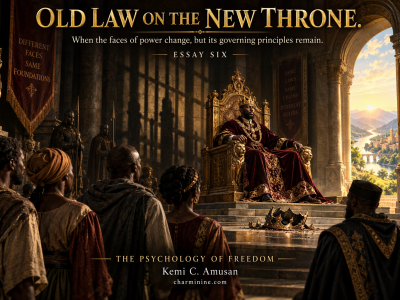
OLD LAW ON THE NEW THRONE depicts a grand medieval throne room rendered in a cinematic Renaissance-inspired style. At the center-right, a newly crowned Black ruler sits with dignity upon an imposing golden throne, dressed in deep burgundy velvet adorned with antique gold embroidery and wearing an ornate crown. At the foot of the throne lies a shattered crown, symbolizing the fallen order. In the foreground, Black men and women from different walks of life stand facing the ruler, emphasizing the relationship between political power and those who live under it. Behind the throne, elongated shadows stretch across ancient stone walls, forming prison-bar patterns that suggest the persistence of oppressive structures despite a change in leadership. To the far right, a majestic archway opens onto a bright, sunlit landscape, representing the possibility of a different social order. Rich tones of antique gold, burgundy, bronze, charcoal, and warm ivory create a regal yet unsettling atmosphere. The cover includes the title OLD LAW ON THE NEW THRONE, the subtitle “When the faces of power change, but its governing principles remain.”, ESSAY SIX, and the branding THE PSYCHOLOGY OF FREEDOM • Kemi C. Amusan • charminine.com.

The Psychology of Freedom Captivity, Conditioning, Healing and Power By Kemi C. Amusan Charminine.com ESSAY SIX OLD LAW ON THE NEW THRONE

Liberation changes where a person stands without necessarily changing what they believe power is. The former servant may become the lord, the excluded may become the gatekeeper, and the once-oppressed may reproduce the very conditions they fought to escape. This essay examines the psychological inheritance of oppression, the wounds that survive success, and the danger of carrying old laws into new positions of authority. It argues that genuine liberation requires two disciplines: inner healing that changes how we understand and exercise power, and external structures that hold power accountable when personal insight fails. For freedom to endure, power must become an instrument of stewardship rather than a means of securing the helplessness of others.

The Psychology of Freedom By Kemi C. Amusan ESSAY THREE   The Garlic of Egypt: Deconditioning and the Loneliness of the Pioneer

ESSAY SERIES The Psychology of Freedom By Kemi C. Amusan Charminine.com ESSAY THREE   The Garlic of Egypt: Deconditioning and the Loneliness of the Pioneer   The Price of Refusing the Role Laws may be changed, institutions remade, and the distribution of resources altered, yet the mind can remain loyal … More The Psychology of Freedom By Kemi C. Amusan ESSAY THREE   The Garlic of Egypt: Deconditioning and the Loneliness of the Pioneer »

The Transformative Power of Hope: How Sandy Embodies the Maiden Archetype in Afterlife

The Transformative Power of Hope: How Sandy Embodies the Maiden Archetype in Afterlife The Maiden Archetype: Sandy’s Embodiment of Hope Sandy, the bright-eyed intern, embodies the Maiden archetype, radiating innocent beauty, youth, naivety, and fertility. Her arrival at the Tambury Gazette’s office in Season One of Afterlife serves as a … More The Transformative Power of Hope: How Sandy Embodies the Maiden Archetype in Afterlife »

Follow us on Social Media