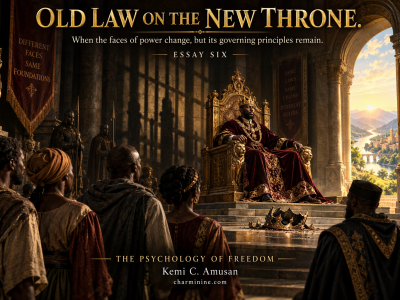
OLD LAW ON THE NEW THRONE depicts a grand medieval throne room rendered in a cinematic Renaissance-inspired style. At the center-right, a newly crowned Black ruler sits with dignity upon an imposing golden throne, dressed in deep burgundy velvet adorned with antique gold embroidery and wearing an ornate crown. At the foot of the throne lies a shattered crown, symbolizing the fallen order. In the foreground, Black men and women from different walks of life stand facing the ruler, emphasizing the relationship between political power and those who live under it. Behind the throne, elongated shadows stretch across ancient stone walls, forming prison-bar patterns that suggest the persistence of oppressive structures despite a change in leadership. To the far right, a majestic archway opens onto a bright, sunlit landscape, representing the possibility of a different social order. Rich tones of antique gold, burgundy, bronze, charcoal, and warm ivory create a regal yet unsettling atmosphere. The cover includes the title OLD LAW ON THE NEW THRONE, the subtitle “When the faces of power change, but its governing principles remain.”, ESSAY SIX, and the branding THE PSYCHOLOGY OF FREEDOM • Kemi C. Amusan • charminine.com.

The Psychology of Freedom Captivity, Conditioning, Healing and Power By Kemi C. Amusan Charminine.com ESSAY SIX OLD LAW ON THE NEW THRONE

Liberation changes where a person stands without necessarily changing what they believe power is. The former servant may become the lord, the excluded may become the gatekeeper, and the once-oppressed may reproduce the very conditions they fought to escape. This essay examines the psychological inheritance of oppression, the wounds that survive success, and the danger of carrying old laws into new positions of authority. It argues that genuine liberation requires two disciplines: inner healing that changes how we understand and exercise power, and external structures that hold power accountable when personal insight fails. For freedom to endure, power must become an instrument of stewardship rather than a means of securing the helplessness of others.
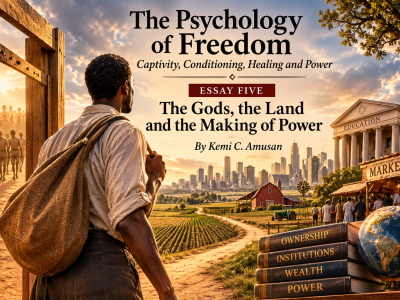

The Psychology of Freedom Captivity, Conditioning, Healing and Power By Kemi C. Amusan ESSAY FIVE The Gods, the Land and the Making of Power

      The Psychology of Freedom Captivity, Conditioning, Healing and Power By Kemi C. Amusan ESSAY FIVE The Gods, the Land and the Making of Power   Freedom can open a door, but it cannot rearrange the street beyond it. The land was divided before the newly freed arrived. … More The Psychology of Freedom Captivity, Conditioning, Healing and Power By Kemi C. Amusan ESSAY FIVE The Gods, the Land and the Making of Power »

The Psychology of Freedom By Kemi C. Amusan ESSAY FOUR The Open Door and the Empty House

    The Psychology of Freedom Captivity, Conditioning, Healing and Power By Kemi C. Amusan Charminine.com ESSAY FOUR The Open Door and the Empty House     Freedom can arrive in a single moment, but living free takes years. A door may be opened, a master dethroned, a right restored, … More The Psychology of Freedom By Kemi C. Amusan ESSAY FOUR The Open Door and the Empty House »

The Psychology of Freedom By Kemi C. Amusan ESSAY THREE   The Garlic of Egypt: Deconditioning and the Loneliness of the Pioneer

ESSAY SERIES The Psychology of Freedom By Kemi C. Amusan Charminine.com ESSAY THREE   The Garlic of Egypt: Deconditioning and the Loneliness of the Pioneer   The Price of Refusing the Role Laws may be changed, institutions remade, and the distribution of resources altered, yet the mind can remain loyal … More The Psychology of Freedom By Kemi C. Amusan ESSAY THREE   The Garlic of Egypt: Deconditioning and the Loneliness of the Pioneer »

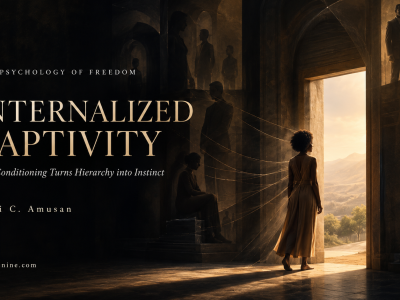
The Psychology of Freedom By Kemi C. Amusan ESSAY TWO Internalized Captivity

  ESSAY SERIES The Psychology of Freedom Captivity, Conditioning, Healing and Liberation By Kemi C. Amusan Charminine.com ESSAY TWO Internalized Captivity   From Repetition to Instinct What we meet repeatedly becomes easier to recognise, anticipate, and answer. Social life works the same way. A child who keeps seeing authority attached … More The Psychology of Freedom By Kemi C. Amusan ESSAY TWO Internalized Captivity »

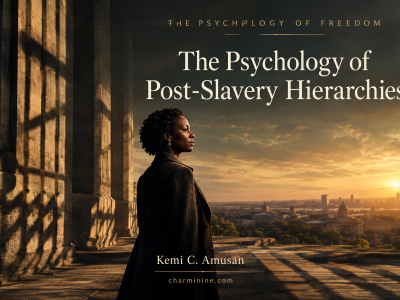
The Psychology of Freedom Captivity, Conditioning, Healing and Liberation By Kemi C. Amusan ESSAY ONE The Psychology of Post-Slavery Hierarchies

ESSAY SERIES The Psychology of Freedom Captivity, Conditioning, Healing and Liberation By Kemi C. Amusan Charminine.com ESSAY ONE The Psychology of Post-Slavery Hierarchies   The Paradox of Paper Freedom When slavery ended in the United States, Black people became legally free. The Thirteenth Amendment, ratified in 1865, abolished slavery except … More The Psychology of Freedom Captivity, Conditioning, Healing and Liberation By Kemi C. Amusan ESSAY ONE The Psychology of Post-Slavery Hierarchies »

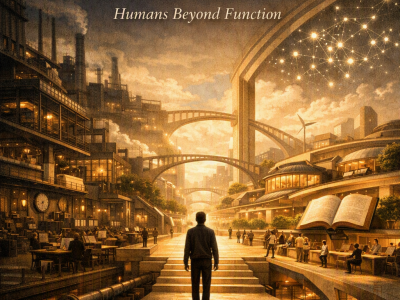
Humans Beyond Function Redesigning Access to Life When Machines Do the Work Kemi C. Amusan Essay VI The Architecture of Access

What if the next great expansion of human prosperity depends less on producing ever more, and increasingly on becoming extraordinarily sophisticated at connecting people to the value civilization has already created? Google organized access to knowledge. Spotify reorganized access to music. Wikipedia transformed participation into collective intelligence. Open source turned distributed contribution into technological infrastructure. Artificial intelligence is now making expertise increasingly accessible. Even the humble biodigester reveals the same principle by transforming overlooked organic waste into energy and agricultural inputs. Across these seemingly unrelated innovations lies a common pattern: narrowing the distance between existing value and human participation. Production built the modern world. Access may determine who is ultimately able to inhabit it.

Humans Beyond Function Redesigning Access to Life When Machines Do the Work Kemi C. Amusan Essay V The Age of Access

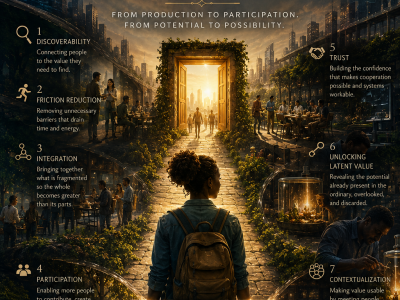
Industrial civilization became remarkably skilled at creating value. The next civilization may be judged by something different: how effectively it enables people to reach, use, and participate in the value civilization has already created. Access is not a philosophy of sameness or redistribution. It is a philosophy of possibility, concerned with the barriers that separate human potential from the conditions through which that potential can become useful.

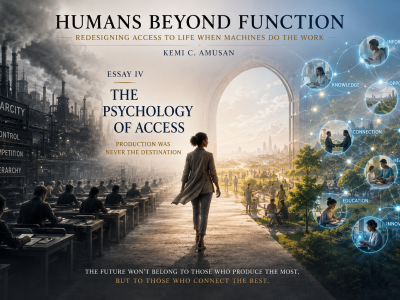
Editorial cover image for Humans Beyond Function: Redesigning Access to Life When Machines Do the Work, Essay IV, The Psychology of Access, by Kemi C. Amusan. A woman walks from a dark industrial landscape marked “Scarcity,” “Control,” “Competition,” and “Hierarchy” toward a bright, connected future representing information, knowledge, opportunity, connection, healthcare, education, and innovation. The image includes the phrase “Production Was Never the Destination.”

Humans Beyond Function Redesigning Access to Life When Machines Do the Work Kemi C. Amusan ESSAY IV The Psychology of Access

As machines become increasingly capable of producing what humanity needs, the central challenge of civilization may no longer be production—but access. The next great transformation will depend on how effectively we connect people to the knowledge, opportunities, institutions, technologies, and resources that already exist. This is not simply an economic transition. It is a psychological one: from a civilization shaped by scarcity, control, and accumulation toward one increasingly organized around connection, participation, and reduced friction.

Futuristic AI figure holding a glowing orb beside an ancient city of philosophers, connected by a bridge under a blended cosmic and sunrise sky.

Humans Beyond Function Redesigning Access to Life When Machines Do the Work Kemi C. Amusan Essay III The Ceiling We Forgot: Rediscovering the Purpose of Civilization

Artificial intelligence is often discussed as a threat to jobs, but that debate may be asking the wrong question. The deeper challenge is not whether machines will replace human labour, but whether modern civilization has become so organized around production that it has forgotten what production was always meant to serve. Drawing on Aristotle, Amartya Sen, Martha Nussbaum, religious traditions, and contemporary debates about AI, this essay argues that work was never humanity’s ultimate purpose. Instead, employment became the industrial-age foundation upon which societies distributed income, dignity, identity, and opportunity. As AI weakens the historical link between labour and production, it exposes a forgotten distinction between the floor of civilization—its material foundations—and its ceiling: human flourishing. The question before us is therefore not simply how to preserve jobs, but how to redesign institutions so that technological abundance expands freedom, creativity, citizenship, and human potential. Rather than viewing artificial intelligence as merely an economic disruption, this essay explores why it may represent the beginning of a profound civilizational transition and why recovering humanity’s forgotten purpose has become one of the defining challenges of the twenty-first century.

Follow us on Social Media