
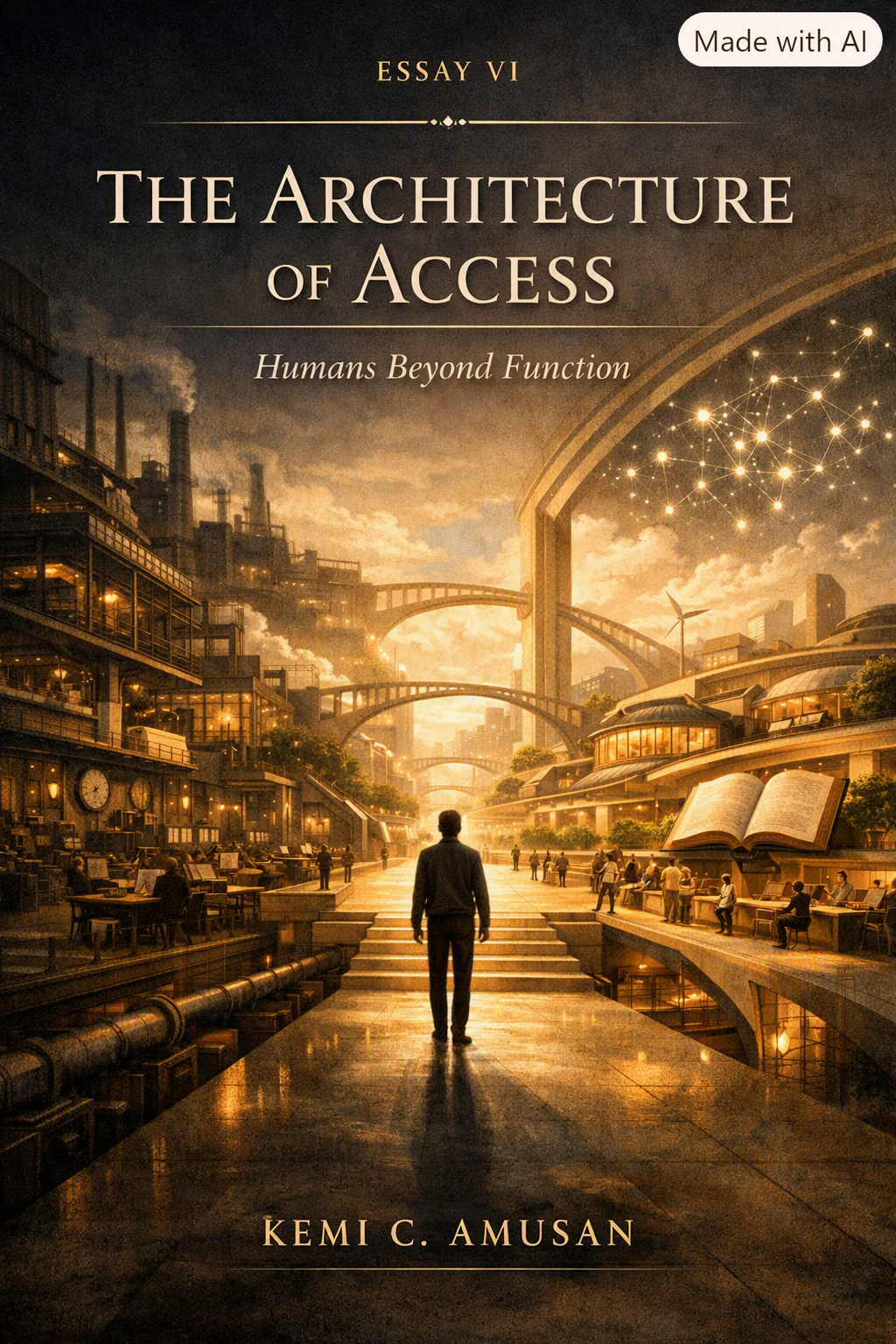
Humans Beyond Function
Redesigning Access to Life When Machines Do the Work
Kemi C. Amusan
Essay VI
The Architecture of Access
The temptation is to reduce access to a collection of individual technologies, successful companies, or government programmes. Yet doing so would miss the larger pattern. Google is not important because it is Google. Spotify is not important because it streams music. Artificial intelligence is not important because it writes code or answers questions. Each matter because it reveals something about the governing principles through which value increasingly moves within civilization.
Beyond the product, the real innovation is the redesign of the pathway between human beings and something that already possessed value.
Before search engines matured, much of the world’s knowledge already existed. Universities possessed it. Libraries preserved it. Researchers published it. Governments archived it. Millions of websites quietly accumulated it. Information was not absent. It was scattered. The challenge facing civilization was increasingly not production but navigation.
Google did not solve humanity’s ignorance by producing all the world’s knowledge itself. It dramatically reduced the effort required to discover knowledge that already existed.
The value created by Google therefore came less from producing information than from organizing access to it.
That distinction appears subtle until one realizes how many industries are quietly undergoing the same transformation.
Spotify follows a remarkably similar logic.
For centuries, music depended upon ownership. One purchased records, tapes, compact discs, or digital downloads because access required possession. Spotify quietly inverted that relationship. The value no longer lay primarily in owning individual songs. It lay in immediate access to an almost unimaginable catalogue of music organized around discovery rather than scarcity. It reorganized the relationship between people and music.
The same pattern appears across countless digital platforms. Navigation increasingly replaces possession. Connection increasingly replaces accumulation. Discoverability increasingly replaces exclusivity.
Wikipedia offers another variation. Traditional encyclopaedias relied upon relatively small groups of recognized experts producing carefully controlled volumes of knowledge. Wikipedia demonstrated that under the right conditions, millions of individuals could collectively construct an extraordinarily valuable public resource.
The lesson extends beyond encyclopaedias. Participation itself became productive.
The platform succeeded not because it centralized all intelligence, but because it lowered the barriers separating countless individual contributions from one another.
Open-source software illustrates the same principle from yet another direction.
For generations, innovation was frequently imagined as something occurring inside isolated organizations protecting proprietary knowledge from competitors. Open-source communities revealed another possibility. Thousands of individuals distributed across continents could voluntarily collaborate on projects of astonishing complexity, often producing technologies that became foundational to the modern internet itself.
The remarkable feature was that access itself accelerated innovation.
The more people capable of improving a system, the faster the system itself evolved.
Artificial intelligence now appears to extend this trajectory.
Public discussion often frames artificial intelligence primarily through the language of replacement. Which jobs will disappear? Which professions remain safe? Which industries will survive?
While these questions matter, they may obscure another transformation on access to expertise that Artificial intelligence dramatically expands.
Tasks that previously required years of specialized training increasingly become accessible to individuals who possess curiosity but lack formal credentials. Language translation, programming assistance, legal drafting, educational support, creative brainstorming, scientific explanation, data analysis, and countless other capabilities become available to people who would previously have required expensive specialists or years of independent study.
This does not eliminate expertise. Experts remain indispensable. Rather, expertise becomes amplified.
The distance separating ordinary people from sophisticated knowledge begins shrinking.
Civilizations have traditionally measured intelligence according to what individuals carried inside their own minds.
Artificial intelligence increasingly allows civilization to measure intelligence according to what minds become capable of accessing together.
Perhaps this is why artificial intelligence feels simultaneously exciting and unsettling.
It redistributes capability. Not perfectly. Not equally. Not without risks. But unmistakably.
The same principle quietly appears outside the digital world.
The public library remains one of civilization’s greatest inventions precisely because it embodies access in one of its purest forms.
The library does not ask every citizen to purchase every book.
It recognizes that knowledge becomes more valuable when more people can reach it.
Its achievement lies in reducing the barriers separating citizens from learning.
The same observation applies to domestic biodigesters.
At first glance, biodigesters appear to belong entirely within discussions of renewable energy. In reality, they reveal something much larger.
Traditional waste management treats organic refuse as an expense. Households discard it.
Cities collect it. Governments transport it. Landfills receive it.
Every stage assumes the material has completed its useful life.
The biodigester rejects that assumption. Organic waste becomes biogas. Biogas becomes energy. Residual material becomes fertilizer.
The remarkable achievement lies not merely in cleaner technology but in a completely different perception of value.
The streets become cleaner because waste itself has acquired meaning.
People do not simply become more environmentally conscious. The system changes the incentives. Value hidden inside what civilization previously regarded as useless suddenly becomes visible.
Access has once again unlocked abundance that already existed.
This may prove one of the defining patterns of the coming century.
The greatest innovations increasingly emerge less from extracting entirely new resources than from recognizing overlooked ones. Empty rooms become shared accommodation.
Idle vehicles become transportation networks. Unused computing power becomes distributed infrastructure. Household waste becomes energy.
Public knowledge becomes searchable intelligence. Human expertise becomes accessible through artificial intelligence.
Each innovation follows the same underlying logic of narrowing the distance between existing value and human participation. Notice what has quietly changed. Innovation itself begins looking different. Industrial civilization often imagined innovation as increasing production.
A civilization increasingly organized around access begins asking another question.
Where is value already trapped? What remains disconnected? Who remains excluded?
What possibilities remain invisible because existing systems have failed to recognize them?
These questions require seeing relationships rather than merely objects. Connections rather than components.
Potential rather than products. Perhaps this explains why many of today’s most transformative organizations appear less concerned with manufacturing than with organizing.
They organize information. They organize communities. They organize transportation.
They organize communication. They organize payments. They organize collaboration.
Their greatest achievement often lies in reducing friction between people and opportunities that previously remained difficult to reach.
This observation should also caution us against an increasingly popular narrative of technology companies concentrating power, extracting attention, or reinforcing inequality. While there are unintended consequences of transformative technology alongside extraordinary benefits, criticism alone teaches remarkably little.
Civilization advances by understanding the principles responsible for their success, rather than by merely condemning successful systems. Therefore, the more interesting question is what the likes of Google and Spotify have they discovered about access that civilization itself has not yet fully understood?
What principles repeatedly emerge across these very different innovations?
How do they reduce friction? How do they increase discoverability?
How do they integrate fragmented systems? How do they expand participation?
How do they unlock latent value?
These questions move the discussion beyond admiration or resentment, and transform examples into teachers.
And that is how civilizations have always progressed. By studying successful patterns rather than merely copying successful institutions.
The factory was never simply a building. It represented a principle. The university was never simply a campus. It represented a principle. The market was never simply a place.
It represented a principle.
The defining institutions of the twenty-first century are attempting to teach civilization another principle altogether.
That the next great expansion of human prosperity may depend less upon producing ever more, and increasingly upon becoming extraordinarily sophisticated at connecting people to the value that civilization has already created.
Only now are we in a position to define access itself, which is the deliberate reduction of unnecessary barriers between human beings and the conditions that enable flourishing.
Whenever civilization lowers those barriers, whether to knowledge, opportunity, energy, healthcare, creativity, community, capital, or participation, it expands access.
And whenever it expands access, it expands the space within which human potential becomes capable of unfolding. Production built the modern world.
Access may determine who is ultimately able to inhabit it..
The Metrics of a Civilization of Access
Measurements are philosophical declarations disguised as statistics. They reveal what a society considers worthy of attention, what it rewards, what it protects, and ultimately, what it believes civilization exists to accomplish.
The industrial age understood this instinctively.
As production became the organizing principle of economic life, societies developed increasingly sophisticated methods for measuring productive success. Gross Domestic Product estimated the value of economic activity. Productivity measured output per worker. Manufacturing indices tracked industrial performance. Employment statistics measured labour market participation. Corporate earnings measured commercial success. These indicators were not arbitrary. They reflected the central challenge of the age. Civilization sought to increase production because production remained the principal constraint upon human wellbeing.
Those measurements achieved extraordinary things.
They helped governments understand economic performance. They guided investment. They exposed inefficiencies. They accelerated scientific management. They encouraged innovation. They allowed countries to compare progress across time and geography. Entire institutions emerged around improving them because improving them generally meant increasing humanity’s ability to overcome scarcity.
Yet every measurement eventually reaches its horizon. GDP tells us how much economic activity occurred. It tells us remarkably little about whether people can meaningfully participate in the opportunities that activity creates.
Employment tells us how many people have jobs. It tells us little about whether people experience belonging, purpose, trust, creativity, or opportunity outside those jobs.
Income tells us what people earn. It tells us far less about what they are genuinely able to become. These observations do not diminish traditional economic indicators. They simply acknowledge their scope.
Every measurement answers a particular question. The difficulty arises only when civilizations continue asking yesterday’s question after history has begun presenting a different one.
If production organized the industrial age, then productivity naturally became its dominant metric.
If access increasingly becomes the organizing principle of the next stage of civilization, different questions begin demanding equally serious measurement.
Civilizations increasingly organized around access may evaluate themselves according to possibilities. Previous questions such as who could manufacture more efficiently? Who could industrialize more rapidly? Who could accumulate greater economic output?
Become questions about possibility.
How many different forms of human excellence have become genuinely possible?
How many lives capable of flourishing have we made possible?
How many children encounter opportunities their grandparents could scarcely imagine?
How many ideas once trapped by geography now travel freely across continents?
How many communities previously excluded now participate?
How much hidden value has been recognized?
How much human potential has been unlocked?
How easily can people participate in the opportunities civilization creates?
How rapidly can knowledge move to those who need it?
How much latent human capability remains trapped behind unnecessary barriers?
How much trust exists between citizens and institutions?
How accessible are education, healthcare, justice, culture, entrepreneurship, and community?
How effectively does civilization convert productive capacity into human possibility?
How discoverable is opportunity?
How navigable are public institutions?
How easily can citizens continue learning throughout life?
How rapidly can new ideas circulate?
How much unused human capability remains disconnected from meaningful contribution?
How much trust reduces the need for costly systems of control?
How effectively does technology expand participation rather than merely increasing efficiency?
How many barriers have been removed rather than merely managed?
Notice that none of these measures asks whether every individual possesses identical outcomes. Rather, they ask how fully civilization has enabled human possibility.
The distinction matters enormously. Flourishing has never implied uniformity.
Human beings differ profoundly in temperament, ambition, talent, circumstance, personality, and aspiration. Some will build companies. Others will teach children. Some will compose symphonies. Others will restore ecosystems. Some will devote themselves to scientific research. Others will nurture families, strengthen neighbourhoods, cultivate friendships, or preserve cultural traditions. Flourishing does not erase difference. It makes difference possible.
Civilizations organized around production often evaluated people primarily according to economic function because production required such evaluation.
Across the world, governments, researchers, and international organizations increasingly examine indicators that would have seemed peripheral only a generation ago. They measure educational attainment, healthy life expectancy, institutional trust, digital connectivity, environmental sustainability, innovation capacity, social mobility, subjective wellbeing, and civic participation. Different countries employ different frameworks, and each possesses limitations. Yet taken together they reveal Civilization has already begun searching for richer ways to describe success.
Perhaps this explains why countries that consistently perform well across multiple measures often attract such widespread attention.
Their economies matter. But so does the fact that ordinary life appears easier to navigate. Institutions inspire greater confidence. Public spaces function. Education remains broadly accessible. Healthcare is comparatively reliable. Digital infrastructure reduces friction rather than increasing it. Citizens generally trust one another at higher levels.
They reduce unnecessary barriers, make learning easiest, connect entrepreneurs to capital smoother, economies transform waste into value, cultures enable ordinary people to participate most fully in the possibilities they collectively create.
This is where the argument of this entire series lands. Artificial intelligence exposed the possibility that humanity has become remarkably successful at solving one historical problem while leaving another comparatively underdeveloped.
We learned how to produce extraordinary abundance. We are only beginning to learn how to organize access to it.
And that is the deepest gift artificial intelligence has unexpectedly offered. A new mirror.