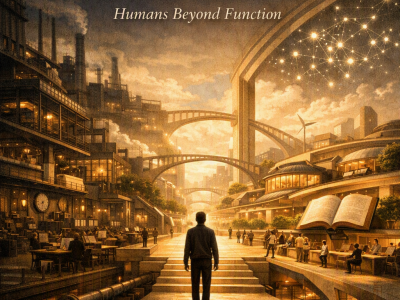
Humans Beyond Function Redesigning Access to Life When Machines Do the Work Kemi C. Amusan Essay VI The Architecture of Access

What if the next great expansion of human prosperity depends less on producing ever more, and increasingly on becoming extraordinarily sophisticated at connecting people to the value civilization has already created? Google organized access to knowledge. Spotify reorganized access to music. Wikipedia transformed participation into collective intelligence. Open source turned distributed contribution into technological infrastructure. Artificial intelligence is now making expertise increasingly accessible. Even the humble biodigester reveals the same principle by transforming overlooked organic waste into energy and agricultural inputs. Across these seemingly unrelated innovations lies a common pattern: narrowing the distance between existing value and human participation. Production built the modern world. Access may determine who is ultimately able to inhabit it.

Futuristic AI figure holding a glowing orb beside an ancient city of philosophers, connected by a bridge under a blended cosmic and sunrise sky.

Humans Beyond Function Redesigning Access to Life When Machines Do the Work Kemi C. Amusan Essay III The Ceiling We Forgot: Rediscovering the Purpose of Civilization

Artificial intelligence is often discussed as a threat to jobs, but that debate may be asking the wrong question. The deeper challenge is not whether machines will replace human labour, but whether modern civilization has become so organized around production that it has forgotten what production was always meant to serve. Drawing on Aristotle, Amartya Sen, Martha Nussbaum, religious traditions, and contemporary debates about AI, this essay argues that work was never humanity’s ultimate purpose. Instead, employment became the industrial-age foundation upon which societies distributed income, dignity, identity, and opportunity. As AI weakens the historical link between labour and production, it exposes a forgotten distinction between the floor of civilization—its material foundations—and its ceiling: human flourishing. The question before us is therefore not simply how to preserve jobs, but how to redesign institutions so that technological abundance expands freedom, creativity, citizenship, and human potential. Rather than viewing artificial intelligence as merely an economic disruption, this essay explores why it may represent the beginning of a profound civilizational transition and why recovering humanity’s forgotten purpose has become one of the defining challenges of the twenty-first century.

Follow us on Social Media