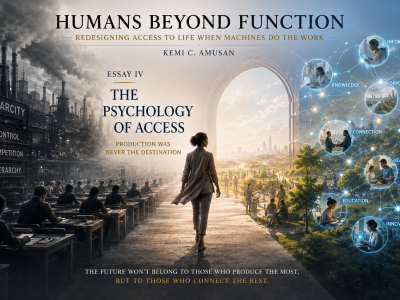
Humans Beyond Function Redesigning Access to Life When Machines Do the Work Kemi C. Amusan Essay VI The Architecture of Access
What if the next great expansion of human prosperity depends less on producing ever more, and increasingly on becoming extraordinarily sophisticated at connecting people to the value civilization has already created? Google organized access to knowledge. Spotify reorganized access to music. Wikipedia transformed participation into collective intelligence. Open source turned distributed contribution into technological infrastructure. Artificial intelligence is now making expertise increasingly accessible. Even the humble biodigester reveals the same principle by transforming overlooked organic waste into energy and agricultural inputs. Across these seemingly unrelated innovations lies a common pattern: narrowing the distance between existing value and human participation. Production built the modern world. Access may determine who is ultimately able to inhabit it.