
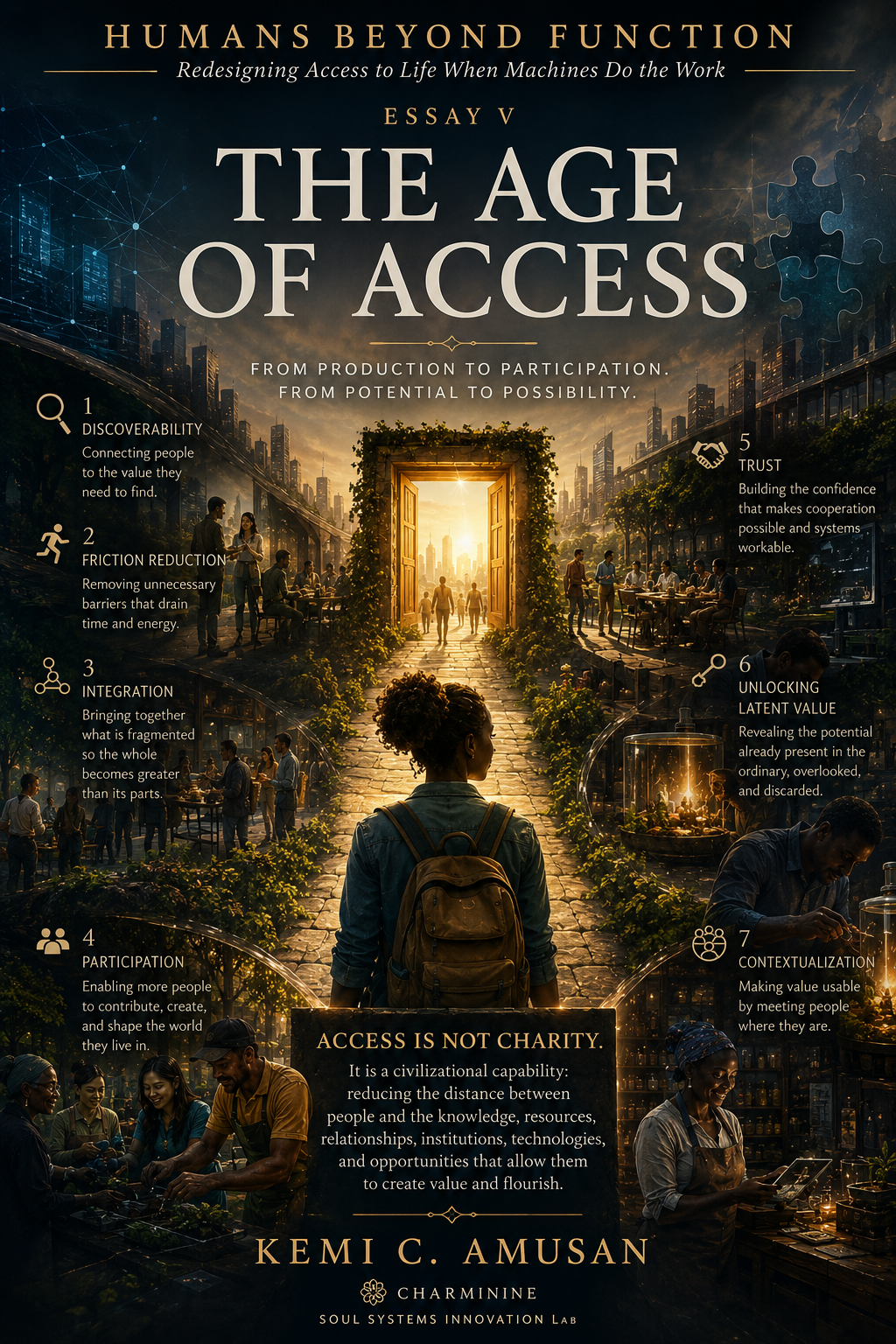
Humans Beyond Function
Redesigning Access to Life When Machines Do the Work
Kemi C. Amusan
Essay V
The Age of Access
A civilization may continue producing extraordinary wealth while leaving millions separated from the conditions required for flourishing by barriers that are institutional rather than technological. It may possess remarkable scientific knowledge while failing to make that knowledge broadly accessible. It may generate unprecedented innovation while allowing opportunity to remain concentrated within relatively narrow networks. The challenge, increasingly, is designing pathways through which more people can participate in the value that civilization already possesses.
This does not imply that every outcome must become equal.
Human beings will continue making different choices, developing different talents, creating different levels of wealth, and pursuing different visions of a good life. Diversity of outcome is neither surprising nor necessarily unjust. Access is not a philosophy of sameness, or whether every person arrives at the same destination.
It is a philosophy of possibility. Its concern is whether unnecessary barriers prevent people from beginning the journey.
Where industrial civilization taught humanity to become remarkably skilled at creating value, the next civilization may increasingly be judged by the sophistication with which it enables human beings to participate in the conditions that enable flourishing
If production answered the defining question of the industrial age, access may increasingly answer the defining philosophical question of the age now beginning. Production, while essential, was only the road that made the journey possible.
The Principles of Access
It would be a mistake to treat access as little more than a synonym for distribution or availability. Access is neither a policy nor a programme. Rather, it is a way of organizing civilization itself. Like production before it, access is governed by principles that quietly shape institutions, technologies, communities, and markets long before they are recognized explicitly.
The Industrial Revolution succeeded because an entire philosophy gradually emerged around production. Specialization increased efficiency. Standardization reduced costs. Division of labour multiplied output. Economies of scale lowered prices. These principles appeared repeatedly across factories, transportation networks, education systems, financial markets, and governments because they reflected a deeper understanding of how productive capacity could be expanded. Civilization became productive because generations of people discovered recurring patterns that made production more effective.
If access is to become an equally serious civilizational competency, it too requires principles. Not rigid laws, but recurring patterns that appear whenever societies successfully reduce the distance between people and the conditions that allow them to flourish. These principles build on production by asking how civilization enables people to participate in value once it has been created.
Principle 1: Discoverability
Discoverability is the capacity of a society to ensure that existing value can be found by the people whose lives it is capable of improving.
While marketing asks how more people can be persuaded to choose a particular product or service, discoverability begins with a human need and asks how the most relevant value can be found, regardless of who created it. Marketing seeks competitive advantage. Discoverability seeks effective matching. One is organized around promotion. The other is organized around connection.
Seen this way, discoverability is more of a civilizational function than an organizational function. Every society depends upon institutions whose primary purpose is to reduce the informational distance between people and value. Libraries make knowledge discoverable. Catalogues make collections discoverable. Maps make places discoverable. Scientific indexes make previous research discoverable. Referral networks make expertise discoverable. Public directories make services discoverable. Even great teachers perform an act of discoverability by revealing ideas, disciplines, and possibilities that students would have been unlikely to encounter on their own.
The extraordinary success of search engines illustrates this principle with unusual clarity. Their greatest innovation was connecting questions with relevant answers. The internet already contained an immense body of knowledge. What search engines changed was the ease with which that knowledge could be located. They dramatically reduced the informational distance between curiosity and understanding.
This principle extends far beyond information. A life-saving treatment cannot heal a patient whose physician never learns it exists. A scholarship cannot transform the future of a student who never discovers it. A talented artist whose work remains unseen contributes only a fraction of what they might have offered the culture. An entrepreneur cannot solve problems for customers who never find the solution. In every case, value exists before connection. Civilization succeeds only when it closes the gap between the two.
Production creates value. Discoverability ensures that value does not remain isolated from the people who need it. The more effectively a civilization connects existing value with human need, the more completely it converts potential into flourishing. Progress, therefore, depends on building institutions that make what already exists reliably discoverable to those whose lives it can change.
Principle 2: Friction Reduction
Friction appears whenever people expend extraordinary effort overcoming obstacles that contribute little to the achievement itself. Long queues, unnecessary paperwork, fragmented information, inaccessible services, disconnected institutions, and overly complex systems all consume human energy without creating corresponding value. They impose costs that frequently remain invisible because societies gradually adapt to them.
Industrial civilization often measured efficiency within production itself. How quickly can factory manufacture goods? How efficiently can supply chains operate? How productively can labour be organized?
An age of access asks how easily can human beings reach the opportunities, knowledge, services, and relationships that already exist?
The distinction is subtle but important. A civilization may possess excellent hospitals while maintaining healthcare systems so difficult to navigate that patients struggle to benefit from them. It may produce extraordinary educational resources while surrounding them with unnecessary barriers. It may possess abundant opportunities while leaving people unable to discover or access them.
Reducing friction therefore creates value by making an existing possibility easier to reach.
Principle 3: integration.
Civilization has a remarkable tendency toward fragmentation. Knowledge becomes separated into disciplines. Institutions become divided into departments. Governments separate responsibilities across ministries. Businesses specialize into functions. Communities become isolated from one another. Information scatters across platforms. Expertise becomes distributed among countless individuals who rarely encounter one another.
Specialization undoubtedly generates extraordinary productive gains. Modern civilization would be impossible without it. Yet specialization also creates fragmentation, and fragmentation carries costs of its own.
Some of the most important innovations in history have emerged because someone recognized relationships that others had overlooked. The internet integrated previously isolated networks. Smartphones integrated dozens of independent technologies into a single device. Artificial intelligence increasingly integrates vast bodies of knowledge that previously required years of specialized training to navigate. Interdisciplinary research repeatedly produces breakthroughs precisely because it reconnects fields that had drifted apart.
Integration therefore represents a philosophy that assumes civilization becomes stronger when disconnected parts begin communicating with one another.
Principle 4: Participation
This distinction matters because exclusion often wastes extraordinary human potential. Throughout history, countless individuals have remained unable to contribute not because they lacked talent, but because barriers prevented participation. Sometimes those barriers were economic. Sometimes they were educational. Sometimes they were geographic, cultural, technological, or institutional. Every unnecessary barrier narrowed the range of voices capable of contributing to civilization’s development.
Participation therefore enlarges civilization not by lowering standards, but by expanding the pool of human capability able to engage with them.
It extends beyond employment. It includes the ability to learn, create, contribute, collaborate, build relationships, develop ideas, join communities, influence institutions, and shape the civilization one inhabits. Human beings flourish not merely because they consume the products of civilization, but because they participate in creating civilization itself.
Principle 5: Trust
Access cannot expand indefinitely in societies incapable of trust.
Every interaction between strangers contains uncertainty. Every institution depends upon expectations about behaviour. Every economy relies upon confidence that agreements will generally be honoured. Trust therefore performs a function far deeper than politeness. It reduces the need for excessive control.
Societies characterized by low trust frequently compensate through bureaucracy, surveillance, rigid hierarchy, or elaborate systems of verification. These mechanisms sometimes prove necessary, but they also generate friction. High-trust societies, by contrast, often enable faster cooperation precisely because people expect institutions and fellow citizens to behave with reasonable reliability.
Trust does not eliminate accountability. Rather, it changes where accountability resides by allowing civilizations replace some forms of control with systems that encourage cooperation, transparency, and shared responsibility.
This observation extends beyond governments. Digital marketplaces depend upon reputation systems. Open-source software depends upon communities capable of collaborative trust. Scientific research depends upon shared standards of evidence. Universities depend upon intellectual trust. Even friendships represent systems through which trust expands what two people become capable of accomplishing together.
Trust therefore functions as infrastructure. Like roads or electricity, its absence is noticed most clearly when it begins to fail.
Principle 6: Unlocking Latent Value.
Industrial civilization often associated innovation with creating something entirely new.
Yet many of humanity’s greatest innovations followed a different pattern. They revealed value that had been present all along.
A search engine revealed how searchable information could become vastly more useful.
A library reveals the collective value of allowing thousands of people to share knowledge rather than keeping it locked upon private shelves.
Artificial intelligence unlocks humanity’s accumulated knowledge by making interaction with that knowledge dramatically easier.
Most societies treat waste primarily as a disposal problem. Once food has been eaten or materials have served their immediate purpose, attention turns toward removing them from daily life as efficiently as possible. Streets become dirty because rubbish appears valueless. Organic waste accumulates because civilization has largely defined it according to what it is no longer capable of doing.
A domestic biodigester quietly reframes the entire system. Waste becomes fuel. Organic refuse becomes fertilizer. What previously required disposal becomes a productive resource.
The significance of this transformation reveals an entirely different way of seeing value. Cleaner streets emerge because the system changes what rubbish means. Once waste possesses recognized value, behaviour begins changing almost automatically. Incentives align. Public benefit and private benefit begin reinforcing one another.
The innovation lies less in producing gas than in recognizing possibility where previous systems perceived only refuse.
Some of the greatest opportunities of the coming century may emerge from learning to recognize value that has remained hidden inside the ordinary, the overlooked, the fragmented, the excluded, and the discarded.
Civilizations that mastered production transformed raw materials into wealth. Civilizations that master access may increasingly transform hidden value into participation.
For if production taught humanity how to create abundance, access may yet teach humanity how to discover how much abundance has been waiting, all along, to be seen.
Principle 7: Contextualization
Access is not achieved merely by making something available. It is achieved when that thing becomes usable within the context of the person who needs it.
Civilization has often confused universality with sameness. If the same institution, service, curriculum, technology, or opportunity is technically available to everyone, society may consider the problem of access solved. Yet identical availability does not produce identical accessibility. People encounter the world from different starting points, with different resources, languages, capabilities, responsibilities, experiences, and ambitions.
A university degree may be available to everyone while remaining inaccessible to someone who cannot afford the tuition, relocate to attend, or leave their livelihood for several years. A sophisticated business course may exist online while remaining practically useless to a market trader who needs to understand cash flow through the realities of daily inventory, informal credit, and mobile payments.
Contextualization asks, what form must value take for this particular person to be able to use it?
The hairdresser who has never received formal business education does not necessarily need an MBA. She may need a practical business school designed around the reality of running a salon: how to price services, calculate margins, manage inventory, retain customers, negotiate with suppliers, train apprentices, use digital platforms, manage cash flow, and determine when the business is ready to expand.
The objective is to translate knowledge into a form through which more people can exercise it.
This principle extends across civilization. Scientific knowledge may need to become understandable to the public. Financial products may need to be intelligible to ordinary households. Technology may need interfaces that accommodate people with different abilities. Professional expertise may need to be translated into tools that non-specialists can use. Educational systems may need multiple pathways into the same capabilities.
Contextualization therefore means recognizing that the distance between knowledge and application is itself a form of inaccessibility, and ensuring that the final distance between the person and the possibility is not created by the form in which the possibility was packaged.
In essence, do not merely make value available. Make it usable.
Access Is Not Charity
Together, these principles suggest that access is not simply about distribution.
It is not charity. It is not merely redistribution. It is not the indiscriminate provision of identical resources. And it is not the elimination of standards in the name of equality.
Access is a civilizational capability: the ability to systematically reduce the distance between human beings and the knowledge, resources, relationships, institutions, technologies, and opportunities through which they can create value and flourish.
Instead of asking only: What can we produce? We begin to ask: Who can reach what we have produced?
Then: Who can use it? Who can participate? Who remains disconnected, and why? What remains disconnected? What value remains hidden?
What unnecessary barriers remain between human potential and human contribution?
And perhaps that is the deeper promise of access, not that everyone receives the same thing, but that fewer human possibilities remain inaccessible simply because the systems around them were never designed to reach them.