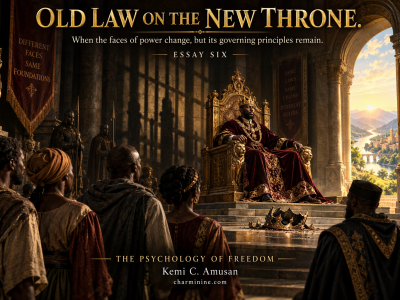
OLD LAW ON THE NEW THRONE depicts a grand medieval throne room rendered in a cinematic Renaissance-inspired style. At the center-right, a newly crowned Black ruler sits with dignity upon an imposing golden throne, dressed in deep burgundy velvet adorned with antique gold embroidery and wearing an ornate crown. At the foot of the throne lies a shattered crown, symbolizing the fallen order. In the foreground, Black men and women from different walks of life stand facing the ruler, emphasizing the relationship between political power and those who live under it. Behind the throne, elongated shadows stretch across ancient stone walls, forming prison-bar patterns that suggest the persistence of oppressive structures despite a change in leadership. To the far right, a majestic archway opens onto a bright, sunlit landscape, representing the possibility of a different social order. Rich tones of antique gold, burgundy, bronze, charcoal, and warm ivory create a regal yet unsettling atmosphere. The cover includes the title OLD LAW ON THE NEW THRONE, the subtitle “When the faces of power change, but its governing principles remain.”, ESSAY SIX, and the branding THE PSYCHOLOGY OF FREEDOM • Kemi C. Amusan • charminine.com.

The Psychology of Freedom Captivity, Conditioning, Healing and Power By Kemi C. Amusan Charminine.com ESSAY SIX OLD LAW ON THE NEW THRONE

Liberation changes where a person stands without necessarily changing what they believe power is. The former servant may become the lord, the excluded may become the gatekeeper, and the once-oppressed may reproduce the very conditions they fought to escape. This essay examines the psychological inheritance of oppression, the wounds that survive success, and the danger of carrying old laws into new positions of authority. It argues that genuine liberation requires two disciplines: inner healing that changes how we understand and exercise power, and external structures that hold power accountable when personal insight fails. For freedom to endure, power must become an instrument of stewardship rather than a means of securing the helplessness of others.
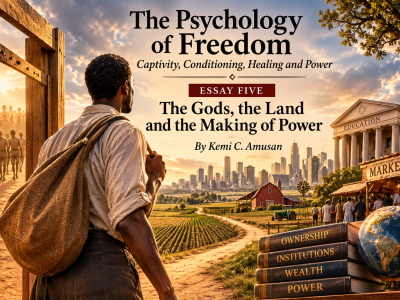

The Psychology of Freedom Captivity, Conditioning, Healing and Power By Kemi C. Amusan ESSAY FIVE The Gods, the Land and the Making of Power

      The Psychology of Freedom Captivity, Conditioning, Healing and Power By Kemi C. Amusan ESSAY FIVE The Gods, the Land and the Making of Power   Freedom can open a door, but it cannot rearrange the street beyond it. The land was divided before the newly freed arrived. … More The Psychology of Freedom Captivity, Conditioning, Healing and Power By Kemi C. Amusan ESSAY FIVE The Gods, the Land and the Making of Power »

Humans Beyond Function Redesigning Access to Life When Machines Do the Work Kemi C. Amusan Essay V The Age of Access

Industrial civilization became remarkably skilled at creating value. The next civilization may be judged by something different: how effectively it enables people to reach, use, and participate in the value civilization has already created. Access is not a philosophy of sameness or redistribution. It is a philosophy of possibility, concerned with the barriers that separate human potential from the conditions through which that potential can become useful.

The Exhausted Civilization Why Modern Life Has Forgotten How Living Systems Work By Oluwakemi C. Amusan Chapter Four What the Symptoms Are Trying to Tell Us

The Exhausted Civilization Why Modern Life Has Forgotten How Living Systems Work By Oluwakemi C. Amusan   Chapter Four What the Symptoms Are Trying to Tell Us   Distortions are rarely visible in themselves. We do not wake up thinking about disrupted oscillation or fractured resonance. We experience something more … More The Exhausted Civilization Why Modern Life Has Forgotten How Living Systems Work By Oluwakemi C. Amusan Chapter Four What the Symptoms Are Trying to Tell Us »

Follow us on Social Media