
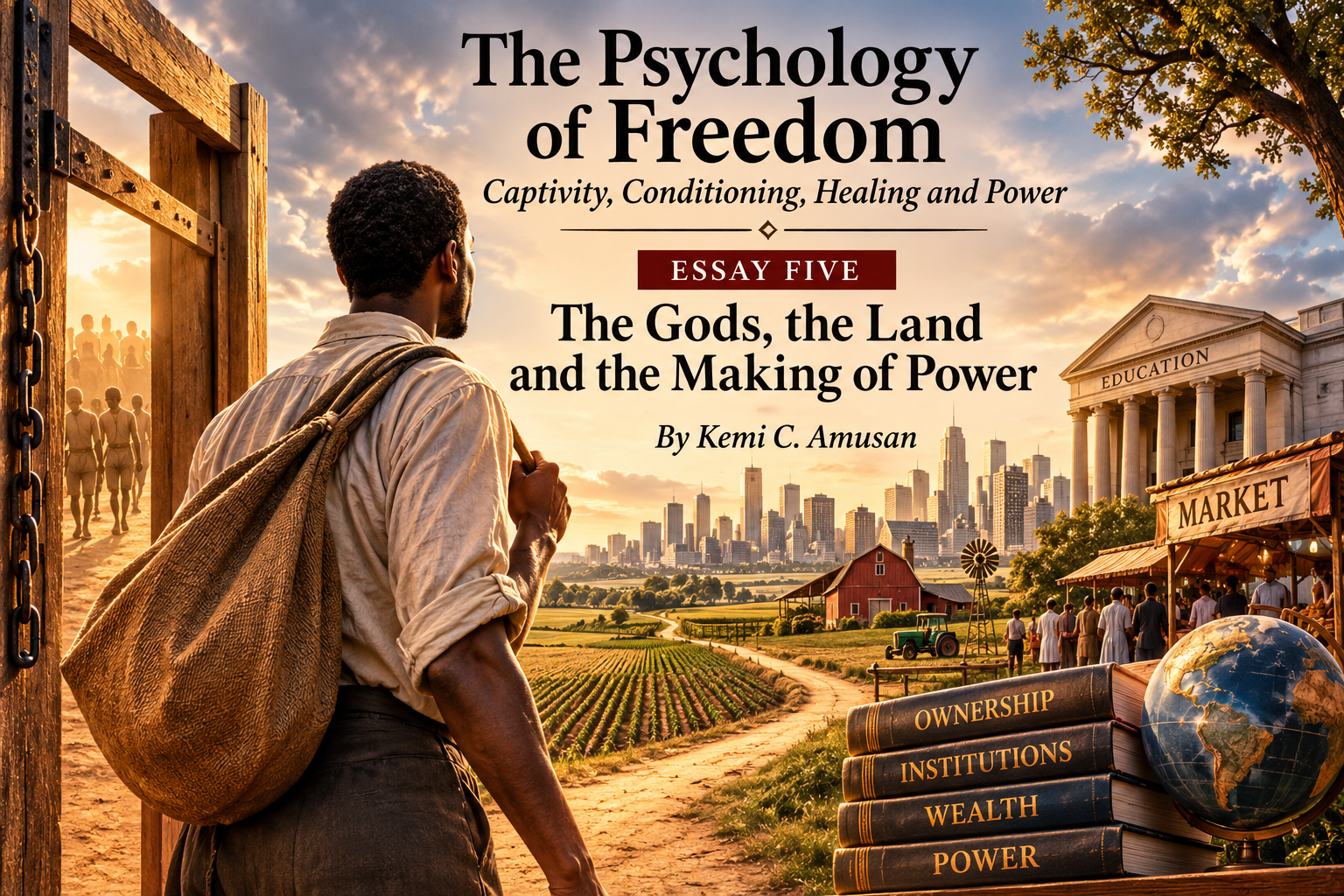
The Psychology of Freedom
Captivity, Conditioning, Healing and Power
By Kemi C. Amusan
ESSAY FIVE
The Gods, the Land and the Making of Power
Freedom can open a door, but it cannot rearrange the street beyond it. The land was divided before the newly freed arrived. The markets have their established traders, credit moves through familiar hands, and the schools have long decided which knowledge deserves honour. Generations of inherited advantage have given some families a start that others must spend their lives trying to attain. The house is the freed man’s to furnish, but the ground it stands on was surveyed by other hands.
What must be built after the door has been opened? The answer is power: the means, the ownership and the institutions that make independence last. Yet power is not the end of the labour. It is the instrument of it. Its purpose is to enlarge the range of choices a person may meaningfully make, and its worth is judged by what it permits him, and others, to do. A man who has gathered great power and has fewer choices than before has gathered a burden. Two losses wait for those who build too little. A man may be shortchanged by the ground on which he began, or diminished by what is asked of him in return for a place. Freedom that guards against neither has opened the door onto a debt.
The Circle of Need
Every arrangement between persons is an exchange. The labourer gives his hours and receives wages. The farmer gives his crop and receives a price. The artist gives a performance and receives a fee, and the child gives obedience and receives shelter. What decides the terms of such a bargain is seldom justice and rarely effort. It is need. The party who needs the other less sets the terms, and the party who needs the other more accepts them.
Dependency is the name for that need, and it has two parts: how much a man wants what the other holds, and how few other places he has to find it. A hungry man with one buyer is wholly dependent. A hungry man with five buyers is only hungry. Power is the other face of the same fact. It is the capacity to direct one’s means towards chosen ends, and within an exchange it shows itself as the ability to refuse. The man who can walk away sets terms, and the man who cannot takes them.
These three are bound in a circle. Dependency weakens the power to refuse, and weak refusal wins poor terms. Poor terms leave little to keep, and little to keep deepens the dependency. The circle needs no master to turn it. It turns by arrangement, and it goes on turning when the master has gone. Emancipation removes a man from the circle’s centre, but the circle itself remains. To build power is to break it: to widen the alternatives, to enlarge what is kept, and so to change what the next bargain will cost.
The breaking is done in stages, and each stage is a greater power than the one before. First comes the ground on which a man begins, and the terms that others hold over him. Then comes the price of staying whole, and the habits by which a man binds himself. Then he must find what he carries that others lack, learn to keep what he earns, build his own terms, and at last hold the whole chain through which value passes.
The Ground Beyond the Door
For the man who leaves the plantation after emancipation, the law has changed, and his master no longer holds the same claim upon his labour. He may seek wages, make agreements and keep a household of his own. Yet the land remains with its former owners, the merchants keep their old relationships, and he must find somewhere to live, something to cultivate and a way to feed his family while bargaining with men whose wealth has been gathering for generations. Where there are few places to go, the freedom to refuse exists in law and withers in the daily week.
This pattern is an old one. The woman who leaves a controlling marriage has recovered the right to decide, but she must still find a roof, an income and the means to rebuild, and the tradesman who leaves his employer has the skill, but he needs customers, equipment and a name that others will trust. While both of these have the freedom to direct their affairs, they must learn that for such freedom to hold, it requires money, judgement and the nerve to bear the cost of his mistakes. The departure of the Israelites out of Egypt was extraordinary, but the wilderness asked what departure could not answer: what would hold them together, what would govern them, and what they would become when captivity no longer dictated the shape of their days. The leaving was one labour. The building was another.
Two young men enter the same race. Both are told that the distance is equal and that effort will decide the winner. One has been trained, fed and shod, and has a family that can carry him while he develops. The other has spent his childhood at work, with no training, no equipment and no one to catch him if he falls. The distance is the same. The starting positions are not.
The language of equal opportunity hides this when it treats the moment of entry as the beginning of the story. Some families can fund a venture through its early losses, while others cannot survive a month without wages. The first may blunder and be none the poorer, for reserves stand behind the blunder. The second may have one customer, one source of bread, and no room for error. In her memoir, Viola Davis spoke of the hunger of her childhood and a race in a schoolyard against a boy who had taunted her. Her shoes were too small and hurt her feet, so she took them off and ran without them. The race ended in a tie. There is something revealing about that image: two people can be placed on the same starting line without having been equally equipped to run the race. One has shoes that fit; the other must first overcome the pain of wearing shoes that do not. Yet once the race begins, the conditions are treated as equal, and the outcome is presented as a fair measure of their abilities.
While those who begin with less are not barred from succeeding, they bring more need to every exchange, and so they pay more to arrive and lose more when they fall. To say so does not excuse anyone from the work. It names the work, which is to reduce the need they carry into the room.
The Terms Behind the Terms
After emancipation the master no longer owns the labourer, but he may still own the land the labourer needs. He may keep the store, the credit that makes planting possible, and the buyers to whom the crop must be sold. His legal authority has gone, and his economic position remains. The freedman may negotiate, but from a place where alternatives are few. If he can find no other land, no other lender and no other buyer, the old master’s offer is the only offer, and an agreement called voluntary is one that refusal would make ruinous.
And that way, power survives a change in law. It passes through ownership, access and the control of alternatives. The employee who may resign, but whose employer holds the only door into the trade, is free in the same manner. So is the supplier whose largest customer provides most of his revenue, and the artist whose platform holds the audience. The question is never only whether an arrangement can be refused but whether a credible alternative exists.
There is a subtler difficulty. The former master may change his language without changing his interests. He now offers employment, credit or partnership, and some of these offers are fair while others preserve the old imbalance under a kinder name. The man long accustomed to deference may hesitate to dispute a price, may take less because the buyer is practised in authority, and may fear the loss of the connection more than the loss of the coin. The removal of an outward authority does not remove the inward bond to it.
Confidence may help a man speak, but it cannot replace the savings, the skill and the alternatives that make refusal possible. The terms of an exchange are shaped by what lies open to each party. Land gives a farmer somewhere to plant, and capital lets an entrepreneur endure the lean beginning. An independent route to market, a wider network and an audience reached directly each loosen the hold, because each is a place to go. The power to say no is built long before the day on which refusal becomes necessary.
The Price Paid in Self
A loan founds a business, a scholarship opens a school, and an institution may supply what a promising effort could not find alone. Yet help becomes a chain when the one who receives it must surrender judgement, independence or the right to disagree in order to keep receiving it.
The same test applies in households, employers, charities and courts. The parent who assists a grown son while quietly deciding every weighty matter for him, the employer who grants benefits and discourages the skills that would make his workmen mobile, the benefactor who endows a school and expects its masters to defend his interests: each has made a place, and each has set a price upon it. The business that takes investment for a fair share of ownership and clear duties may grow, while the one that accepts financing on terms it does not understand may find that the price of survival was its future. Generosity becomes a debt that is never allowed to end, and every disagreement is read as ingratitude.
This is the second loss, and it is the harder to see, because nothing visible is taken. A man is given a place, and the place costs him his conscience. The price is seldom named at the outset. It arrives as a small silence, a softened opinion, a belief set aside for the season. Then it becomes the habit of the man.
The true measure of this dependence is often revealed at the moment when obedience is demanded and refusal becomes costly. What does it take to say no when one’s livelihood, reputation, security or place in the world depends upon the approval of those making the demand? Muhammad Ali’s refusal of induction into the United States military in 1967 offers a striking illustration. Citing his religious convictions and opposition to the Vietnam War, he refused to be drafted, knowing that his decision could cost him the career he had built. It did. He lost his boxing licence, years of his prime and the income that came with them. The Supreme Court overturned his conviction in 1971, but the years were not returned to him.
Ali could withstand a cost that would have been ruinous to many others because he had built a standing, a following and a name that no single institution could entirely take from him. His example does not say that every man must pay so high a price, and it would be cruel to suggest so. The right to refuse is not equally available to all, because the consequences of refusal are not equally bearable. A man with no savings, no other source of bread and no friends may be forced to accept terms that another man can reject. The cost of refusal rises with the degree of dependence, and power is, in part, the strength to bear that cost.
Dave Chappelle shows the same law from another side. In 2005, at the height of its fame, he left his television programme rather than go on as the machine around him required. The popular account of the fortune he is said to have refused has been disputed, and it need not be settled here. What is documented serves the argument better. Under the agreement he had signed, the network remained free to license the programme without his consent. He had given the work, and the work went on earning in hands that were not his. Each of these men paid a price, and both are instructive: the man who will not be diminished must be ready to pay, and the man who owns nothing of his work has less to pay with. A freedom that survives only by yielding the self was never quite freedom.
The Habit of Mind That Keeps the Gate Closed
Not every restraint is written in law or contract. Some are carried in habits that outlast the conditions that produced them. The child punished for questioning learns that disagreement is dangerous. The employee who has been humiliated learns that safety lies in hiding his ability. The community long shut out learns to lower its hopes, not for want of ambition, but because hoping has cost too much. Obedience once protected the child, silence the employee, and caution the family with nothing to spare. Such adaptations make sense where they were formed. The difficulty begins when the conditions change and the habits remain, for then the circle of need turns within the man himself, and the gate is held shut from the inside.
There are virtues we are taught to admire so unconditionally that to question them seems a transgression: patience, humility, endurance, loyalty, sacrifice. When a man cannot challenge an arrangement, he may call his submission patience. When he cannot assert himself, he may call his silence humility. When he cannot leave, he may call his staying loyalty, and when he cannot claim what he needs, he may call his want sacrifice. What began as an adaptation acquires the authority of a principle, and in time the man defends the very dispositions that confine him.
Nietzsche gave the name ressentiment to a deeper form of this turning, in which a people long unable to act condemns the qualities of strength and raises its inability into a virtue. Ambition begins to look suspect. The wish for wealth is called greed, the wish for influence arrogance, and the builder is accused of deserting those he left behind, while those who remain in hardship are praised for their patience. The idea must be used with care. Wealth can be won by exploitation, and not every criticism of ambition is envy. The point is narrower. A community is trapped when it condemns the pursuit of power more readily than it examines the conditions that keep power from its hands. The moral high ground can become a comfortable place from which to watch one’s circumstances remain unchanged.
This does not make the old virtues worthless. Patience gives strength to endure the time that building requires. Humility permits a man to learn what he does not know. Endurance carries him through the hard stages of any worthwhile labour, and sacrifice is needed when something lesser must be surrendered for something greater. But these belong to the road. They are companions for the passage, not reasons to remain at the starting place. A virtue that keeps a man from freedom has outlived its purpose.
What a People Brings to the Table
Beneath the struggle for livelihood lies a deeper question: what becomes of a people taught to distrust the inheritance from which its own sense of possibility might have grown? A people that arrives with nothing of its own to offer can sell only its labour, on terms set by whoever sets the standard. A people that arrives with something the others lack changes who needs whom.
Before colonial rule, African societies held diverse faiths, forms of government, bodies of knowledge, systems of education, agricultural arts and commercial networks. They were not uniform and not beyond criticism, having their own conflicts, limits and changes. The colonial encounter often ranked them beneath European religion, learning and institutions, which were offered as the measure of civilisation. Indigenous worship was called superstition, local languages were treated as obstacles to schooling, and inherited knowledge was displaced by imported curricula. The history was more complicated than the replacement of one civilisation by another. Africans interpreted, resisted and remade what they met, and Christianity and Islam took root through conversion, negotiation and local agency that cannot be reduced to coercion. Yet the hierarchy that held indigenous religion and knowledge to be primitive left lasting marks, and scholars of African religious history have documented how missionary and colonial discourse represented native practice as illegitimate while exalting European forms.
When a people’s gods are called false, its ancestors ignorant and its customs backward, the injury reaches the way it understands itself. The inherited world becomes something to escape, the mother tongue something to outgrow, and the standards of another society the measure of its own life. Its young learn to link sophistication with foreign voices and foreign approval. Its entrepreneurs assume that a good idea must first be certified elsewhere, and its scholars spend more years proving that their subject deserves study than developing the knowledge it contains. Such a people deals from weakness, for it has agreed in advance that the goods of others are the only goods worth having, and every bargain it makes begins with that concession.
The gods and the land are therefore images of what a people may hold that cannot be bought elsewhere. The gods stand for the meanings, the spiritual imagination and the inherited knowledge through which a people has read existence. The land stands for the material ground of life, with the resources, skills and institutions that let a community sustain itself. To return to them is no retreat from the world. It is to claim that an inheritance which is not Western is not therefore lesser, and that, examined deeply enough, it yields a vantage the borrowed one cannot. The Yoruba understanding of the Orí, the inner head that holds a person’s destiny and is addressed in prayer, is an old theory of the self and its direction, and it has more to say to the modern study of agency than its dismissal as superstition allowed.
The Jewish communities of medieval and early modern Europe offer a lesson in the same matter, though their history is distinct, their conditions varied by region and by century, and the comparison concerns mechanism, not essence. Where land could be seized, guilds could bar entry, and a commercial position could be destroyed by expulsion, learning, languages, skills and bonds of trust could still travel. A community that faces the possibility of displacement has reason to invest in the means that survive displacement, and many of them did. What a people alone can offer lessens its need of others, and lessened need is where leverage begins.
The demand is severe. No civilisation is strengthened by refusing to examine its past, and some customs deserve to be abandoned, some institutions to be reformed, and some beliefs no longer serve the present. The inheritance earns its place by being tested, refined and put to use, and not by being old. Nor is there any strength in refusing useful knowledge because it came from elsewhere, for civilisations have always grown by exchange. A firm foundation makes that exchange richer. It lets a people learn without erasing itself, and cooperate without making permanent dependence the price of entry.
From Income to Wealth
A man long denied the chance to earn may associate wealth with the things once beyond his reach: fine cloth, a handsome house, the freedom to spend without asking leave. These can stand for arrival and the restoration of dignity, and there is nothing wrong in enjoying the fruits of labour. The danger begins when spending becomes the chief expression of success while the means that could secure the future are neglected.
Income and wealth are different things. Income is received for work. Wealth is what remains and grows when the work is done. A skilled tailor may earn his bread for forty years, while the house that supplies his cloth, owns the shop and holds the customer takes the larger share of what his hands create. The skill is his. The position from which it is exercised belongs to someone else. A degree is the same: knowledge opens a door, but it becomes independence only when it is turned into work, the work into income, and the income into something that stays.
Consider two entertainers who earn equal fortunes. The first spends it sustaining a manner of living that demands continued high earnings. The second uses part of it to acquire rights, make investments and cultivate an audience he can reach directly. Their incomes are the same at the outset, but their futures are not. When the audience moves elsewhere, the first must perform at the same pitch to meet his obligations, while the second has gathered means that furnish him further choices. High recurring expenses turn success into an obligation to keep succeeding at the same rate.
The stages of growth are plain. A man first learns to earn by offering what the market values. He then learns to keep a part of what he earns, turning income into savings, skill and holdings. Last, he may command the means through which further value is made. Michael Jackson, whose art needs no defence, grasped that the ownership of creative work is itself an asset, and bought the ATV catalogue with its Beatles publishing rights. The song was an income, but the catalogue was a wealth that went on yielding when the performer rested.
There is a further matter, and it joins this rung to the one before. When a man does not own enough of what his talent produces, he may in the end be obliged to hire out his name and public voice to maintain the life his talent once financed. His freedom to disagree grows ever more costly as his livelihood leans on continued patronage. The question is not how much a man can display after a successful season. It is what remains when the season has passed.
Building Beyond the Gate
Every society has its gates. Some are formal: licences, qualifications, memberships and contracts. Others are informal, held by reputation, acquaintance and the unspoken judgement of those who decide whose work deserves notice. Gates are not always illegitimate, for some protect standards and ration scarce means. The trouble comes when access depends on the discretion of those who use their position to preserve their advantage and keep others in need of their approval.
A man may spend years seeking admission, and sometimes the years are well spent, for the house may hold experience and connections that would be costly to reproduce. But a time comes when the question must change. If he has shown his worth and met a ceiling that has little to do with the quality of his work, how much longer should his future depend on persuading the gatekeeper? What else could be built?
The Harlem Renaissance shows both the strength and the limit of cultural power. Hughes, Hurston and McKay gave literary form to Black life, and musicians carried jazz into the nation’s ear. Yet the clubs, record companies and publishers that brought this work to wider audiences were largely owned elsewhere. The Cotton Club presented Black performers to an audience and an ownership that reflected the hierarchy of the day. A people could shape the culture of a nation while remaining outside the institutions that financed and sold it. The lesson is not to diminish the achievement but to understand the next stage of the work. Recognition does not transfer ownership, and a man who performs upon another’s stage enriches another’s house.
Some answered by building the stage. Madam C. J. Walker made a haircare enterprise for women whom the great firms had neglected, and trained the agents who carried it to them. John H. Johnson founded Ebony and Jet for a readership the mainstream press overlooked. Black Americans built churches that were also schools and meeting halls, colleges such as Fisk, Howard, Morehouse and Tuskegee when others closed their doors, and banks and insurers for those the great houses ignored. Maggie Lena Walker’s St. Luke Penny Savings Bank gave Richmond’s Black families a place to save. The National Medical Association was founded in 1895 because Black physicians were barred from the American Medical Association, and the Chicago Defender and the Pittsburgh Courier carried news and argument that the mainstream press neglected or distorted. Jewish communities, whose history is distinct and should not be confused with this one, built institutions under their own exclusions and for the same reason: in Europe, societies for loans, charity and burial, and in America, immigrant aid societies, a Yiddish press, hospitals, and in 1948 Brandeis University, founded in a country where Jewish students had met quotas elsewhere.
The history also warns how fragile such work is without capital, protection and wide markets. Greenwood, in Tulsa, was destroyed in 1921, and the Freedman’s Savings Bank failed in 1874, taking with it the savings of thousands of the newly free. The founding of an institution is only the first part of the labour. Its governance, its finances and its defences matter as much as its purpose. The individual builds strength, but the community builds continuity.
Building beyond the gate changes the cost of refusal. The existing road need not be abandoned. It becomes one road among several, and the gatekeeper, though he may still command a particular opportunity, no longer commands every opportunity that matters. A venture of one’s own sets its own terms, and an alternative is what makes the old arrangement optional.
Owning the Chain of Value
To create value and to command what becomes of it are different things. A man may be exceptionally gifted, earn large sums and receive public honour, and yet remain outside the structures that decide how his work is distributed and turned to profit. He may make the product and not own the rights. He may draw the customers and have no direct tie with them. He may create the demand while another party holds the channel through which that demand becomes revenue.
The chain of value is the whole course by which value is made, delivered and taken. In music it runs from the writing of the song through the recording, the publishing, the master, the distribution, the touring and the merchandise, to the bond with the audience. The great question is where control resides at each link, and who takes the surplus. Prince saw this clearly. In the 1990s he fell into open dispute with Warner Bros. over the rights to his recordings, and he appeared in public with the word “slave” written upon his cheek. The quarrel was not for the money he earned. It was for the masters he made and the authority to decide their use.
Tyler Perry is the plainest example of the climb. He began as a writer and performer, with stories that found an audience, and he might have remained dependent on other men’s studios and distributors to bring them to the screen. Instead he built an enterprise around the work. He kept the story and the intellectual property, then formed the company, gathered the equipment and the craftsmen, and raised a great studio in Atlanta, where others make their work upon his ground. Agreements with distributors and broadcasters carry his productions to audiences beyond the walls he owns. He need not hold every network or channel to treat with those who do. It is enough to command the strategic links, so that no single intermediary may name his terms. The studio also becomes a resource that employs others, and ownership begins to outlast the labour of the owner.
The same principle appears elsewhere. Oprah Winfrey carried a broadcasting career into Harpo Productions and a wider enterprise of media, and became owner of the machinery through which her own influence earned. Rihanna saw a market that the established houses had neglected, and built Fenty Beauty around it. Her arrangement was not that of a founder who raised everything outside the great firms. The venture was launched in 2017 in partnership with Kendo Brands, a house of the LVMH group, and the ownership was reported to be held in equal shares between her and her partner. That does not diminish the achievement. It shows another face of power: to discern an unmet demand, to bring a name and an audience to it, and to negotiate a place within the enterprise that serves it. Chappelle, whose programme could be licensed without his consent, stands as the shadow of these figures. He gave the work, and others held the chain.
None of this should harden into a rule that every gifted person must found an empire. Most enterprises stay small, and fortune and timing shape the rest. Ownership may take the form of shares, land, rights, a direct tie with one’s customers, or a business that does not depend on a single patron. The cocoa nation that learns to process what it grows has moved up the same ladder as the artist who owns his master. Ownership, moreover, is no escape from dependence. It brings obligations to workmen, creditors and the officers of the state. It is the acquisition of greater power over the conditions under which dependence is borne.
Here the ladder ends, and the circle is broken at its tightest point. The man who owns the chain holds greater command of the terms on which he is paid and heard, and others must treat with him as a party and no longer as a petitioner. Effort alone never settled the outcome. Its direction mattered, and so did the arrangements within which it was spent. Power begins to grow when the means a person holds begin to reinforce one another, when income buys an asset, the asset yields income, and reputation draws the customer who keeps the whole in motion.
The Road Beyond the Open Door
The freedman stands in the marketplace. The door behind him is open, but the world before him still bears the arrangements of the past. He must find land and credit, build alliances, and understand the difference between earning and owning, between taking part and holding control, between receiving help and surrendering himself. Yet the market is not the only place where his future is decided. He must also choose what knowledge to carry forward, what traditions to keep, and what manner of life he means to build. The history of his people holds more than the memory of bondage, and what was done to them does not exhaust what they are.
So it is with any person, community or nation emerging from dependence. Freedom opens the door. Power is built from the means that make refusal possible, the ownership that lets value endure, the institutions that carry achievement beyond a single lifetime, and an inheritance examined until it speaks. Each of these lessens need, and lessened need breaks the circle at the point where it was tightest. The task is to enter the world with something of one’s own to bring to it, and the means to build from what one has brought.
That is how the open door becomes a life. But the man who has built such power holds, for the first time, the means to shape the lives of others as well as his own, and what he does with that is the last test of freedom. Ownership cannot answer it alone.