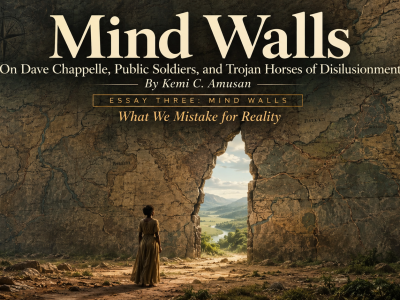
Mind Walls On Dave Chappelle, Public Soldiers, and Trojan Horses of Disillusionment By Kemi C. Amusan Essay One: The Soldiers Who Never Enlisted Why We Expect Public Figures to Fight Our Ideological War

This essay examines why we turn public figures into ideological representatives they never agreed to be. From Dave Chappelle to actors, musicians, activists, and celebrities, we explore how admiration becomes ownership, contradiction becomes betrayal, and human beings disappear beneath the symbols we assign to them. The deeper problem is not that public figures change, contradict themselves, or make choices we dislike. It is that we often need them to remain fixed because their identities have become part of the architecture through which we understand ourselves.

FALLEN ANGELS Kemi C. Amusan CHAPTER 4: FATE OF CRYSTAL

Heaven thought she had finally found the courage to expose Danielle, the woman she blamed for destroying her marriage, her friendships, and Crystal. But four weeks into writing her explosive confession, something has changed. Haunted by a mysterious child named Crystal and unraveling under the weight of betrayal, pills, and revenge, Heaven is confronted by her estranged husband, Terrence. Then he reveals a secret that could destroy the last piece of Heaven’s carefully constructed innocence.

The Christmas Debt Kemi C. Amusan CHAPTER 3: An Elf Came Crip Walking

Maya has spent years turning Christmas into a spectacle her family, friends, and social media followers will envy, even as her credit-card debt quietly spirals out of control. But when an unsettling Santa decoration begins speaking, moving, and inspecting everything she owns, Maya discovers that some purchases come with consequences. And her seven handcrafted elves are only getting started.

The Revolt of the Cat Ladies Kemi C. Amusan Chapter 1: Election Night

The Revolt of the Cat Ladies Kemi C. Amusan Chapter 1: Election Night   The votes came in just after nine o’clock, and by nine-fifteen, the fellowship hall at First Baptist had gone silent in a way that made Dorothy Cunningham smile. She stood at the front of the room … More The Revolt of the Cat Ladies Kemi C. Amusan Chapter 1: Election Night »

Humans Beyond Function Redesigning Access to Life When Machines Do the Work Kemi C. Amusan Essay VI The Architecture of Access

What if the next great expansion of human prosperity depends less on producing ever more, and increasingly on becoming extraordinarily sophisticated at connecting people to the value civilization has already created? Google organized access to knowledge. Spotify reorganized access to music. Wikipedia transformed participation into collective intelligence. Open source turned distributed contribution into technological infrastructure. Artificial intelligence is now making expertise increasingly accessible. Even the humble biodigester reveals the same principle by transforming overlooked organic waste into energy and agricultural inputs. Across these seemingly unrelated innovations lies a common pattern: narrowing the distance between existing value and human participation. Production built the modern world. Access may determine who is ultimately able to inhabit it.

Humans Beyond Function Redesigning Access to Life When Machines Do the Work Kemi C. Amusan Essay V The Age of Access

Industrial civilization became remarkably skilled at creating value. The next civilization may be judged by something different: how effectively it enables people to reach, use, and participate in the value civilization has already created. Access is not a philosophy of sameness or redistribution. It is a philosophy of possibility, concerned with the barriers that separate human potential from the conditions through which that potential can become useful.

Editorial cover image for Humans Beyond Function: Redesigning Access to Life When Machines Do the Work, Essay IV, The Psychology of Access, by Kemi C. Amusan. A woman walks from a dark industrial landscape marked “Scarcity,” “Control,” “Competition,” and “Hierarchy” toward a bright, connected future representing information, knowledge, opportunity, connection, healthcare, education, and innovation. The image includes the phrase “Production Was Never the Destination.”

Humans Beyond Function Redesigning Access to Life When Machines Do the Work Kemi C. Amusan ESSAY IV The Psychology of Access

As machines become increasingly capable of producing what humanity needs, the central challenge of civilization may no longer be production—but access. The next great transformation will depend on how effectively we connect people to the knowledge, opportunities, institutions, technologies, and resources that already exist. This is not simply an economic transition. It is a psychological one: from a civilization shaped by scarcity, control, and accumulation toward one increasingly organized around connection, participation, and reduced friction.

Futuristic AI figure holding a glowing orb beside an ancient city of philosophers, connected by a bridge under a blended cosmic and sunrise sky.

Humans Beyond Function Redesigning Access to Life When Machines Do the Work Kemi C. Amusan Essay III The Ceiling We Forgot: Rediscovering the Purpose of Civilization

Artificial intelligence is often discussed as a threat to jobs, but that debate may be asking the wrong question. The deeper challenge is not whether machines will replace human labour, but whether modern civilization has become so organized around production that it has forgotten what production was always meant to serve. Drawing on Aristotle, Amartya Sen, Martha Nussbaum, religious traditions, and contemporary debates about AI, this essay argues that work was never humanity’s ultimate purpose. Instead, employment became the industrial-age foundation upon which societies distributed income, dignity, identity, and opportunity. As AI weakens the historical link between labour and production, it exposes a forgotten distinction between the floor of civilization—its material foundations—and its ceiling: human flourishing. The question before us is therefore not simply how to preserve jobs, but how to redesign institutions so that technological abundance expands freedom, creativity, citizenship, and human potential. Rather than viewing artificial intelligence as merely an economic disruption, this essay explores why it may represent the beginning of a profound civilizational transition and why recovering humanity’s forgotten purpose has become one of the defining challenges of the twenty-first century.

A young boy sits at a desk in a neatly ordered classroom, gazing out a large window. Outside, golden fields are harvested by self-driving machines, drones hover above, and robotic arms work in distant factories. Inside, children continue their lessons, while beyond the glass the world operates without human labour. The image contrasts traditional education with an automated future.

Humans Beyond Function Redesigning Access to Life When Machines Do the Work Kemi C. Amusan Essay II The Cost That Didn’t Move The Fracturing of Human Identity in the Age of Machines

Imagine, for a moment, attempting to calculate the cost of participating in civilisation itself. Not the biological cost of staying alive, but the price of belonging to ordinary social life. We often assume that housing, healthcare, security, and stability are simply features of modern life. Yet access to them remains overwhelmingly conditional on sustained economic participation. As technology has steadily reduced the amount of human labour required to produce material abundance, one might expect the cost of participating in society to have fallen as well. Instead, the price has remained remarkably unchanged. This essay explores why modern civilisation continues to organise access to life around economic usefulness, even as the economic conditions that once made such an arrangement necessary have fundamentally changed.

Humans Beyond Function Redesigning Access to Life When Machines Do the Work By Kemi C. Amusan   Essay I The Zero Marginal Cost Society and the Broken Prediction The Shadow Side of Technological Democratization

  Humans Beyond Function Redesigning Access to Life When Machines Do the Work By Kemi C. Amusan   Essay I The Zero Marginal Cost Society and the Broken Prediction The Shadow Side of Technological Democratization Jeremy Rifkin thought he had seen the future. Writing in The Zero Marginal Cost Society … More Humans Beyond Function Redesigning Access to Life When Machines Do the Work By Kemi C. Amusan   Essay I The Zero Marginal Cost Society and the Broken Prediction The Shadow Side of Technological Democratization »

Follow us on Social Media