
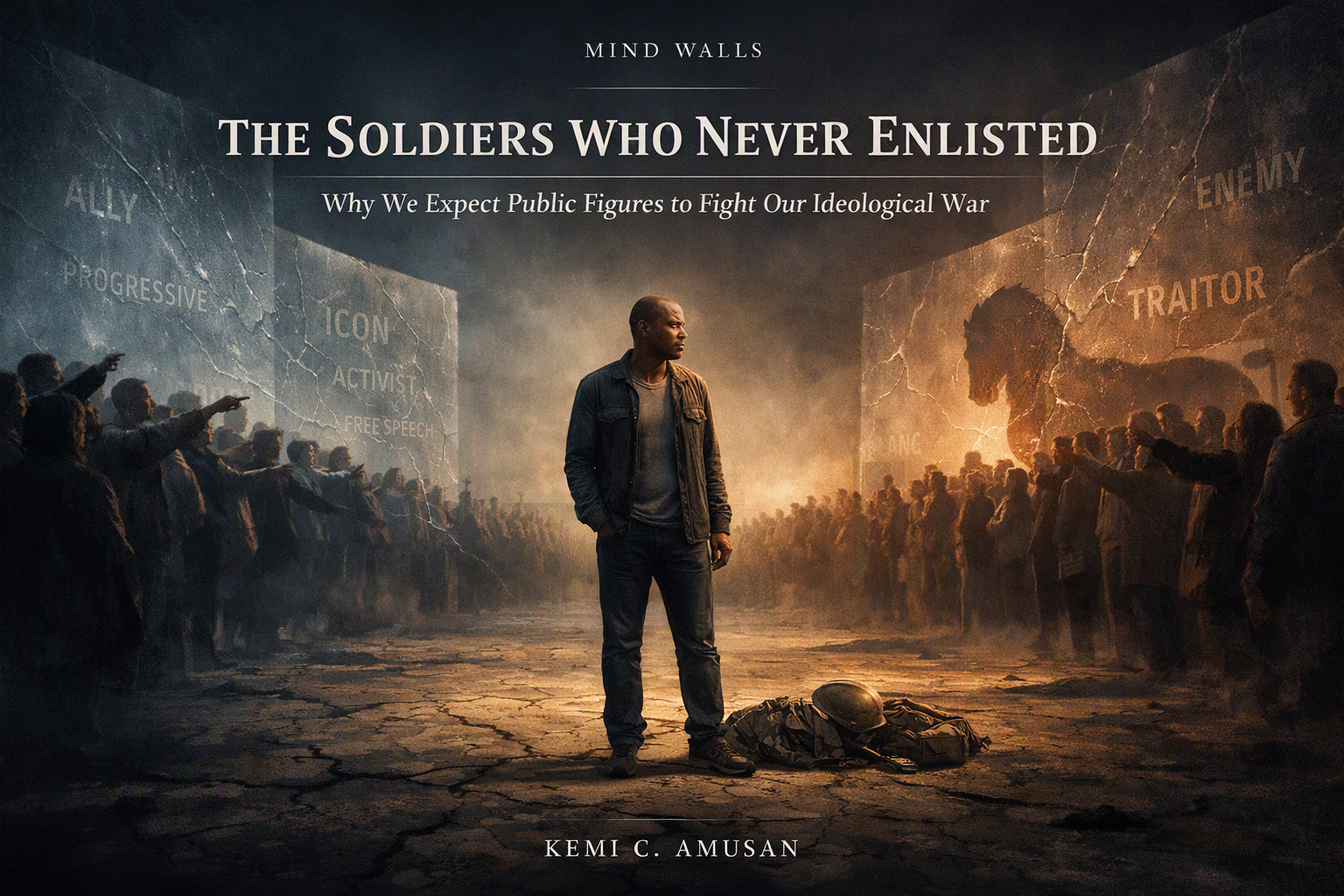
Mind Walls
On Dave Chappelle, Public Soldiers, and Trojan Horses of Disillusionment
By Kemi C. Amusan
Essay One: The Soldiers Who Never Enlisted
Why We Expect Public Figures to Fight Our Ideological War
The relationship we have with public figures is deeply peculiar. We speak about them as though they belong to us. We celebrate them when they affirm the stories we tell ourselves about the world, mourn them when they disappoint us, defend them when others attack them and condemn them when they wander beyond the invisible boundaries we had quietly drawn around their lives. Somewhere along the way, without contracts being signed or promises being made, we conscript them into wars they never enlisted in. A comedian tells a joke and millions of people hear a political declaration. An actor accepts an invitation to a particular podcast and suddenly the invitation itself becomes a statement. A musician performs in a country whose government we despise, a celebrity becomes friendly with someone from the opposing political camp, a writer praises an individual our tribe has decided is beyond redemption, and what might have been an ordinary human decision is transformed into evidence of allegiance. We begin asking questions that sound strangely military for people discussing entertainers, writers and athletes. Whose side are they on? Have they crossed over? Are they helping the enemy? Have they abandoned us?
Increasingly, our public discourse reduces itself to three deceptively simple words: pick a side. It sounds like a demand for courage. Sometimes it genuinely is. There are moments when neutrality is cowardice, when silence protects the powerful and when a person with influence has a legitimate responsibility to speak. But we are asking them to remain where we first found them. We want the comedian to remain the comedian we discovered when his jokes confirmed something we already believed. We want the activist to remain permanently aligned with our conception of justice. We want the feminist to dislike the people we dislike, the conservative commentator to oppose the things we oppose, the Black entertainer to carry the political aspirations of Black America exactly as we understand them, and the free-speech advocate to defend speech only when that speech does not disturb our own moral tribe. We begin to organize our understanding of them around what they are supposed to represent.
This is where admiration quietly becomes ownership. Not legal ownership, of course, but something psychologically similar. We begin to feel that because we have invested attention, affection, money, identity or emotional energy in a person, that person owes us continuity. The public figure becomes a kind of unwritten agreement. We found you here, we say without actually saying it, and therefore you must remain here. We liked you because you stood for this. You cannot now stand for that. We watched you, defended you, bought your work, quoted your words and allowed you to become part of the architecture of our identity. In return, we expect you to remain recognisable. The expectation is rarely negotiated because it feels like common sense.
That is why contradiction can feel so offensive. When Dave Chappelle does something that unsettles people who have understood him through a particular political lens, the disagreement is rarely confined to the action itself. The action becomes evidence that the person they thought they knew was somehow false. When Michelle Obama shares a warm moment with George Bush, the image can become, for some observers, something far larger than two human beings being warm toward one another. It becomes a symbolic event. When a Curtis Jackson performs somewhere politically controversial, when an actor appears beside the wrong person, when a writer compliments an ideological opponent, the audience encounter it through a symbolic system they have already built. The question becomes, What does this mean about who this person really is?
And because we are accustomed to interpreting the world through categories, the answer often arrives before curiosity has had a chance to intervene. We know what this person is. Progressive. Conservative. Feminist. Activist. Libertarian. Christian. A feminist icon. A Black cultural figure. A free-speech warrior. A champion of the working class. A voice for the voiceless. Once the category has been established, everything else is interpreted through it. Their actions become evidence for or against the category. Their contradictions become problems to be solved. Their inconsistencies become scandals. Their friendships become political statements. Their business decisions become moral declarations. Their private choices become public betrayals. The person gradually disappears beneath the meaning we have assigned to them.
There is a reason symbols are so attractive to us. Symbols are wonderfully stable. Human beings are not.
A symbol can stand for something without becoming tired, changing its mind, falling in love with the wrong person, making a foolish commercial decision, developing an unexpected friendship, discovering that an old belief no longer makes sense or simply waking up one morning and wanting something different from what it wanted five years earlier. A symbol does not have to reconcile competing desires. A symbol does not have a mortgage, a mother, a spouse, a child, a business partner, an old friend, a private insecurity or an inconvenient ambition. A symbol does not have to decide whether making money from something compromises the purity of its politics. A symbol does not have to sit across from someone it disagrees with and discover that it still likes them.
A human being does.
That is the inconvenience of actual humanity. We contain contradictions that cannot always be reconciled neatly. We can believe strongly in one principle and violate it under pressure. We can admire someone whose politics we despise. We can condemn an institution and still accept an invitation from it. We can care deeply about justice and also care about money. We can want to change the world and want to be left alone. We can hold a political conviction for twenty years and then discover that experience has altered it. We can be generous in one part of our lives and selfish in another. We can be courageous publicly and frightened privately. None of this necessarily makes us frauds. It makes us human.
Yet we find this much harder to accept in people we have elevated into public symbols than we do in ourselves.
We understand instinctively that our own lives contain complexity. We allow ourselves explanations. We remember the context. We know what happened before the decision and what happened afterward. We know what we meant, even when what we did looked foolish. We know the private pressures that shaped our choices. We know that a person can be inconsistent without being entirely insincere. But we do not possess this interior access to public figures. We see fragments. Interviews. Speeches. Performances. Photographs. Posts. Headlines. Clips. A few minutes of a podcast. A statement from ten years ago. A recent decision. We assemble these fragments into a coherent person because coherence makes people easier to understand. And once we have assembled that person, we begin defending the construction as though it were the person themselves.
This is where the strange psychology of public life begins. We do not simply observe people. We use them.
We use them as landmarks in a confusing moral landscape. We use them to tell ourselves who we are. We use them to confirm that our politics are reasonable, that our values are shared, that people like us exist and that the world can still be understood through the categories we have chosen. The celebrity, activist, journalist or artist becomes a reference point. She believes what I believe. He sees what I see. They understand what is happening. The public figure becomes a kind of external confirmation of our internal world.
And this is why their contradiction can feel strangely personal.
If someone we have never met makes a decision we dislike, why should it hurt? Why should the business decision of an entertainer alter our emotional state? Why should the friendship of a celebrity with a politician feel like a betrayal of us personally? Why should a comedian’s political ambiguity threaten our own political identity? The answer is that, at some point, the person ceased to exist for us merely as a person. They became part of the structure through which we understand ourselves.
Their contradiction therefore creates a contradiction inside us.
If this person is good, and good people do not do this, then what do we do with what they have done? We have several options. We can reconsider our definition of the person. We can acknowledge that goodness does not guarantee ideological consistency. We can accept that someone can be admirable in one respect and disappointing in another. We can distinguish between an action and an entire identity. We can ask why the person made the decision. We can tolerate not knowing. All of these require intellectual and emotional effort.
Or we can simplify.
They were never who we thought they were.
That sentence is psychologically efficient. It closes the file. It eliminates ambiguity. It allows us to preserve the category even when the human being no longer fits inside it. The problem, we tell ourselves, is that the person was secretly something else all along.
This is one of the quiet costs of ideological life. The more heavily we depend on categories to organize reality, the more threatening human complexity becomes. We begin to demand consistency not merely because consistency is virtuous, but because inconsistency destabilizes the maps we use to navigate the world. We want the people who populate our moral landscape to remain in their designated places. The conservative should stay conservative. The progressive should stay progressive. The feminist should remain sufficiently feminist. The activist should remain sufficiently activist. The celebrity should continue endorsing the causes we associate with their brand. The person who once helped us articulate our worldview must not suddenly become evidence against it.
So we turn people into soldiers.
We give them uniforms they did not request and missions they did not accept. We assign them ranks. We place them on one side of a battlefield and watch their movements for signs of disloyalty. We interpret a friendship as defection, a performance as collaboration with the enemy, a business decision as ideological surrender. We congratulate them when they fire in the direction we approve of and condemn them when they refuse to fire at all.
But there is something almost absurd about the arrangement.
The soldier never enlisted.
The comedian did not promise to preserve our politics. The actor did not sign a contract requiring ideological purity. The musician did not agree to become the permanent representative of our moral values. The celebrity did not ask to become a symbol of everything we believe about justice, race, gender, freedom, capitalism or democracy. We assigned the role because the role was useful to us.
This does not mean public figures have no moral responsibilities. Of course they do. Influence matters. Power matters. Money matters. Platforms matter. Some people use public influence to manipulate, exploit, deceive or cause real harm. A public figure can be criticized. They can be held accountable. They can lose an audience. We are not required to admire someone simply because they are talented, famous or entertaining. Nor should the language of “they are only human” become an excuse for cruelty, dishonesty or abuse.
The question is narrower and more difficult: what exactly do we believe a public figure owes us simply because they are visible?
Does visibility itself create obligation? Does admiration create entitlement? Does the fact that millions of people identify with someone give those millions a legitimate claim over that person’s friendships, commercial decisions, political evolution or private life? At what point does accountability become ownership? At what point does moral expectation become ideological conscription?
Perhaps the distinction we need is between what a person does and what we have decided that person represents.
We can judge an action without demanding that the person remain a perfect embodiment of our worldview. We can disagree with someone without requiring their total moral exile. We can withdraw admiration without rewriting their entire character. We can say, I think that was wrong, without necessarily saying, therefore everything I believed about you was false. Most importantly, we can allow a human being to become more complicated without experiencing that complication as an attack on ourselves.
The real betrayal is the moment our carefully constructed image of them collapses, and we discover that the person was never the symbol.