
The Revolt of the Cat Ladies
Kemi C. Amusan
Chapter 2: The Christmas Luncheon
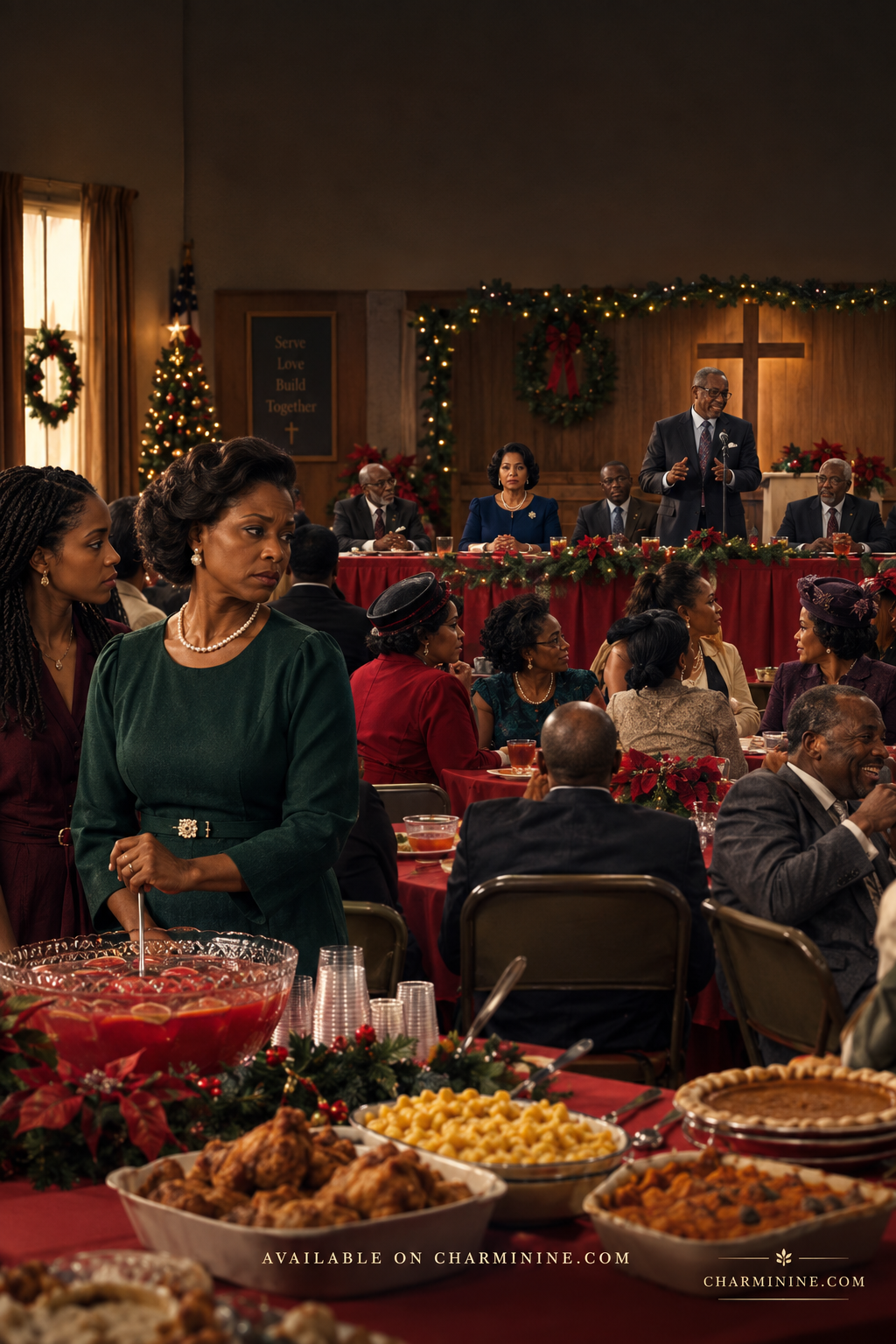
First Baptist’s fellowship hall smelled like ham and green beans and too much perfume, and it was the first Sunday in December, the annual Christmas luncheon in full swing. Long tables stretched the length of the room, covered in red tablecloths and laden with casserole dishes, platters of fried chicken, sweet potato pies, macaroni and cheese baked to golden perfection. The church ladies had been cooking since Friday.
Emma sat at a table near the back with Colin and his family, half-listening as his mother, Diane Barrett, dabbed her mouth with a napkin and worked through a mental checklist of wedding venues. Diane wore a cream-colored suit and a hat with a small veil that made her look like she was attending a funeral instead of a church luncheon.
“Now, the Gardens at Willow Creek are nice,” Diane was saying, “but they book up fast. You’ll want to call them this week. And you’ll need to think about catering. I know a woman in Atlanta does beautiful work, very elegant…”
“Mama,” Colin said, grinning, “we just got engaged three days ago. Give her a minute.”
Diane waved him off without looking up from her list. “A minute is all it takes for someone else to snatch up your date. Isn’t that right, Emma?”
“Yes, ma’am,” Emma said, forcing a smile.
Diane smiled back as though the answer had settled something and returned to her list.
Across the table, Colin’s father, William Barrett, owner of Barrett Motors, the only car dealership in Emberhill, was talking to someone about the election, and Emma caught the tail end of it.
“Don’t care what anybody says, it’s embarrassing,” William said, shaking his head. “Woman her age, never been married, living alone with all those animals…”
“Daddy,” Colin said, still grinning but with an edge now, “maybe we don’t do this here.”
William just shrugged and said, “Just saying,” and went back to his plate.
Emma glanced toward the front of the room, where Dorothy Cunningham sat at the head table with Pastor Mike and a few of the deacons, wearing a navy dress and pearls, her posture perfect, her expression serene. She looked, Emma thought, like she belonged there.
Near the kitchen, a group of women had gathered around Linda Marshall, laughing loudly enough to draw glances. Emma recognized most of them: Janet Hayes, a divorce lawyer with a sharp tongue and sharper heels; Patricia Cole, who taught second grade and hadn’t been the same since she left her husband last year; Maureen Jacobs, the retired high school English teacher everyone loved.
Emma’s mother, Grace, stood near the punch bowl, refilling cups, not laughing at all. If anything, she looked like a woman waiting for a reason to leave.
“Excuse me,” Emma said, standing. “I need to…”
“Don’t be long,” Diane said, already back in her list. “We need to talk about the guest list.”
Grace Hartley had perfected the art of invisible exhaustion.
She smiled when she was supposed to smile. Nodded when she was supposed to nod. Stood next to Robert at church functions and town events and Rotary dinners, her hand resting lightly on his arm, her lipstick never smudged, her hat never askew.
And inside, she was so tired she could barely breathe.
“Mama.”
She turned. Emma was walking toward her, weaving between tables.
“You okay?” Emma asked.
“I’m fine, baby. You need something?”
“Just needed to get away from Mrs. Barrett for a second.” Emma picked up a cup of punch, sipped it, made a face. “This is so sweet.”
“Always is.” Grace refilled another cup, set it on the table. “How’s Colin?”
“He’s good. His mom’s already planning the wedding.”
“That’s Diane.”
They stood in silence for a moment, watching the room. At the head table, Pastor Mike was standing, tapping his glass with a fork. The room quieted.
“Brothers and sisters,” he said, his voice carrying easily, “before we finish up, I want to take a moment to acknowledge our new mayor, Sister Dorothy Cunningham.” Polite applause followed, and Dorothy inclined her head to accept it. “Now,” Pastor Mike continued, “I know there’s been some talk. Some concern about the direction our town might be headed. And I want to remind everyone that leadership is a sacred responsibility. It requires wisdom. It requires humility. And it requires submission to God’s will.”
The room had gone very still.
“When a woman steps into a role of authority,” Pastor Mike said, his tone measured, careful, “she must remember that God has a design for how things are meant to be. The family is the foundation of society. And the family, as we know, is led by the man.” Grace’s hand tightened on the ladle at that, the knuckles going pale, though her face didn’t change. “So I encourage all of us,” Pastor Mike went on, smiling now, “to pray for Sister Cunningham. Pray that she leads with wisdom. And pray that she remembers her place in God’s order.”
A voice cut in from the middle of the room before the applause could start. “Or let’s just pray she finds a man,” the voice said, easy and loud, “a husband who can lead on her behalf.” It belonged to Avery Johanson, a heavyset man in a suit a size too tight, who owned the casino boat moored at the edge of town and who was not, by any account, native to Emberhill, though rumor had it that two or three of the church elders had found their way onto his payroll one way or another. He said it the way a man says something he expects to be laughed at, already grinning before anyone else did.
“Now, now,” Pastor Mike said, holding up a hand, though there was a smirk tucked into the corner of his mouth he didn’t quite manage to hide, “I don’t want to encourage a lack of courtesy in the house of God. But perhaps, for the sake of inclusiveness, we might give our dear new convert Avery a moment to air his thoughts.”
The church laughed and clapped, a ripple of amusement moving table to table.
“Ain’t nothing much to be said,” Avery announced, rising halfway out of his chair and hooking his thumbs in his belt. “I could marry Sister Dorothy myself. Teach her something about life.” He paused, letting the room lean in, then shrugged and dropped back into his seat. “But she old. She old, man.” A fresh round of applause followed him down, scattered laughter riding underneath it.
“Now, now, Avery,” Pastor Mike said again, still smirking, and moved on with his speech as though nothing unusual had happened, the applause louder this time than it had been for the prayer.
Dorothy didn’t move through any of it. She just sat there at the head table, hands folded, face unreadable, while a room full of people she’d just been elected to serve laughed at the idea of her being handed off like property to a stranger with a casino boat.
Grace set the ladle down hard enough that it rattled against the table and walked toward the kitchen without a word. Emma followed her.
“Mama, are you…”
“I’m fine.”
Grace pushed through the swinging door into the kitchen. It was hot back here, steam rising from the industrial sinks, dishes stacked everywhere. Two of the church ladies were scraping plates into the trash.
“Grace, you all right?” one of them asked.
“Just need a minute.”
Grace leaned against the counter, closed her eyes. Her hands were shaking.
The door swung open. Emma stepped inside.
“Mama…”
“Her place.” Grace’s voice cracked on the word. “Like she’s a child. Like she doesn’t have a degree from Spelman. Like she hasn’t been running her own business for thirty years. And Avery…” She shook her head, disgusted. “Who let that lunatic in this fine place of worship, liquor on his breath and a Bible he’s never opened tucked under his arm like a prop?”
Emma didn’t know what to say.
Grace straightened, smoothed her skirt. “I’m sorry. I shouldn’t…”
“No,” Emma said. “You’re right.”
Grace looked at her daughter for a long moment. Then she nodded.
“Come on,” she said. “Let’s get back out there.”
By the time dessert was served, the tension had eased; or at least gone underground.
Robert Hartley sat with Dale Briscoe and a few other men near the far wall. They were drinking coffee, talking in low voices. Every so often, one of them would glance toward the head table where Dorothy sat.
“…could’ve won if we’d pushed harder on the family values angle,” Dale was saying. “People don’t trust a woman who’s got no husband, no kids. Makes ’em nervous.”
“Cats are family too,” someone said, and they all laughed.
Robert didn’t laugh. He was watching Colin, who was standing near the dessert table with Emma, talking to some girl Robert didn’t recognize. Colin had his hand on the small of the girl’s back, just for a second, then moved it when Emma turned around.
Robert’s jaw tightened.
“You all right, Robert?” Dale asked.
“Fine.”
“Your daughter’s marrying the Barrett boy, right?”
“That’s right.”
“Good family. William’s a solid man.”
Robert nodded. Didn’t say what he was thinking: The apple doesn’t fall far.
Across the room, Colin caught Robert’s eye and grinned. Raised his coffee cup in a mock toast.
Robert looked away.
Near the kitchen, Linda Marshall was holding court.
“I’m just saying,” she was saying, gesturing with a fork, “if men can’t handle a woman being in charge, maybe the problem isn’t the woman.”
Maureen Jacobs laughed. “Girl, you’re gonna get us all in trouble.”
Linda looked at the three of them, then around the table. There were about ten women total. Some married, some divorced, some single. All of them looking at her like she’d just said something dangerous.
“So what do we do?” Patricia asked.
Linda shrugged. “Just keep drinking.”
They laughed loud enough that a few people at nearby tables turned to look.
Across the room, Dale Briscoe muttered something under his breath. His crew laughed.
After the luncheon, Robert pulled Colin aside in the parking lot, the December wind cutting between the parked cars.
“Mr. Hartley,” Colin said, grinning as he shook Robert’s hand. “Good to see you, sir.”
“Colin,” Robert said, and they stood there a moment, Colin’s smile not wavering at all. “You remind me of someone.”
“Yeah?” Colin’s smile flickered. “Who’s that?”
“Me,” Robert said. “When I was your age.”
Colin laughed, a little too loud for the joke.
“Well, I’ll take that as a compliment, sir.”
“It’s not.”
The smile died on Colin’s face.
Robert stepped closer, lowering his voice.
“I know what you are. And you will not do to my daughter…”
“What you did to her mother?” Colin interrupted. “With all due respect, Mr. Hartley…”
“I see. I was right about you,” Robert said.
They stared at each other while families loaded into cars around them, kids running across the lot, engines starting one after another in the cold.
Finally, Colin smiled again, thinner this time. “Let’s both have a good evening, Mr. Hartley.” He turned and walked back toward his car. Midway, he turned.
“I do love your daughter, by the way. She’s the type of rose you want to hide in your home.”