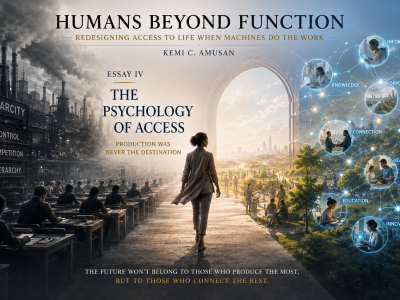
Editorial cover image for Humans Beyond Function: Redesigning Access to Life When Machines Do the Work, Essay IV, The Psychology of Access, by Kemi C. Amusan. A woman walks from a dark industrial landscape marked “Scarcity,” “Control,” “Competition,” and “Hierarchy” toward a bright, connected future representing information, knowledge, opportunity, connection, healthcare, education, and innovation. The image includes the phrase “Production Was Never the Destination.”

Humans Beyond Function Redesigning Access to Life When Machines Do the Work Kemi C. Amusan ESSAY IV The Psychology of Access

As machines become increasingly capable of producing what humanity needs, the central challenge of civilization may no longer be production—but access. The next great transformation will depend on how effectively we connect people to the knowledge, opportunities, institutions, technologies, and resources that already exist. This is not simply an economic transition. It is a psychological one: from a civilization shaped by scarcity, control, and accumulation toward one increasingly organized around connection, participation, and reduced friction.


Futuristic AI figure holding a glowing orb beside an ancient city of philosophers, connected by a bridge under a blended cosmic and sunrise sky.

Humans Beyond Function Redesigning Access to Life When Machines Do the Work Kemi C. Amusan Essay III The Ceiling We Forgot: Rediscovering the Purpose of Civilization

Artificial intelligence is often discussed as a threat to jobs, but that debate may be asking the wrong question. The deeper challenge is not whether machines will replace human labour, but whether modern civilization has become so organized around production that it has forgotten what production was always meant to serve. Drawing on Aristotle, Amartya Sen, Martha Nussbaum, religious traditions, and contemporary debates about AI, this essay argues that work was never humanity’s ultimate purpose. Instead, employment became the industrial-age foundation upon which societies distributed income, dignity, identity, and opportunity. As AI weakens the historical link between labour and production, it exposes a forgotten distinction between the floor of civilization—its material foundations—and its ceiling: human flourishing. The question before us is therefore not simply how to preserve jobs, but how to redesign institutions so that technological abundance expands freedom, creativity, citizenship, and human potential. Rather than viewing artificial intelligence as merely an economic disruption, this essay explores why it may represent the beginning of a profound civilizational transition and why recovering humanity’s forgotten purpose has become one of the defining challenges of the twenty-first century.

A young boy sits at a desk in a neatly ordered classroom, gazing out a large window. Outside, golden fields are harvested by self-driving machines, drones hover above, and robotic arms work in distant factories. Inside, children continue their lessons, while beyond the glass the world operates without human labour. The image contrasts traditional education with an automated future.

Humans Beyond Function Redesigning Access to Life When Machines Do the Work Kemi C. Amusan Essay II The Cost That Didn’t Move The Fracturing of Human Identity in the Age of Machines

Imagine, for a moment, attempting to calculate the cost of participating in civilisation itself. Not the biological cost of staying alive, but the price of belonging to ordinary social life. We often assume that housing, healthcare, security, and stability are simply features of modern life. Yet access to them remains overwhelmingly conditional on sustained economic participation. As technology has steadily reduced the amount of human labour required to produce material abundance, one might expect the cost of participating in society to have fallen as well. Instead, the price has remained remarkably unchanged. This essay explores why modern civilisation continues to organise access to life around economic usefulness, even as the economic conditions that once made such an arrangement necessary have fundamentally changed.

Humans Beyond Function Redesigning Access to Life When Machines Do the Work By Kemi C. Amusan   Essay I The Zero Marginal Cost Society and the Broken Prediction The Shadow Side of Technological Democratization

  Humans Beyond Function Redesigning Access to Life When Machines Do the Work By Kemi C. Amusan   Essay I The Zero Marginal Cost Society and the Broken Prediction The Shadow Side of Technological Democratization Jeremy Rifkin thought he had seen the future. Writing in The Zero Marginal Cost Society … More Humans Beyond Function Redesigning Access to Life When Machines Do the Work By Kemi C. Amusan   Essay I The Zero Marginal Cost Society and the Broken Prediction The Shadow Side of Technological Democratization »

Follow us on Social Media