
Humans Beyond Function
Redesigning Access to Life When Machines Do the Work
By Kemi C. Amusan
Essay I
The Zero Marginal Cost Society and the Broken Prediction
The Shadow Side of Technological Democratization
Jeremy Rifkin thought he had seen the future. Writing in The Zero Marginal Cost Society in 2014, he identified a contradiction at the heart of capitalism that appeared capable of transforming the system from within. The same competitive forces that had driven capitalism’s expansion, the relentless pursuit of efficiency, productivity, and lower costs, were gradually creating conditions that could weaken the foundations upon which the system depended. As businesses searched for ways to produce more with less, technology was steadily reducing the marginal cost of creating and distributing certain goods and services. Each additional unit became cheaper to produce, sometimes approaching a cost so close to zero that traditional ideas of scarcity began to appear unstable. One more song could be streamed without requiring another physical copy to be manufactured. One more article could be shared globally without another printing press running. One more piece of software could be reproduced millions of times without a corresponding increase in production costs. Rifkin’s argument was compelling because it did not imagine capitalism being defeated by an external force. Instead, it suggested that capitalism’s own success was creating the technological conditions that could eventually move society beyond some of its traditional assumptions.
The appeal of this vision came from the fact that the transformation was already visible. The digital revolution was not a distant possibility waiting for invention. It was unfolding in everyday life. The internet had changed what people believed was possible by collapsing barriers that had once seemed permanent. A writer no longer needed access to a major newspaper before reaching an audience. A musician no longer needed a record label before sharing work with listeners around the world. A filmmaker no longer needed a traditional studio system before telling a story. Knowledge that had previously been concentrated within universities, libraries, and professional institutions became available through devices carried in the pockets of billions of people. The relationship between creators and audiences changed. The distance between producers and consumers narrowed. Information, once limited by geography and physical distribution, could now move almost instantly across borders. In many areas of the economy, the cost of copying and distributing digital goods fell dramatically, creating the appearance of a world moving from scarcity toward abundance.
For a moment, it seemed reasonable to believe that these changes would produce a deeper economic transformation. If information could be shared freely, if knowledge could circulate without traditional restrictions, and if digital goods could be reproduced at almost no additional cost, then perhaps older assumptions about ownership, access, and exchange would begin to weaken. The emerging internet culture of collaboration, open knowledge, and peer-to-peer creation appeared to support this possibility. Communities formed around shared resources. Open-source projects demonstrated that people could collectively create valuable systems outside traditional corporate structures. Digital platforms allowed individuals to contribute, communicate, and participate in ways that previous generations could hardly have imagined. The promise was not simply that technology would make certain products cheaper, but that this abundance itself might change the organisation of society.
Yet, when the future arrived – despite technology working, costs falling, digital abundance becoming real – the broader transformation that was supposed to follow did not fully materialise, or rather, it materialised and then reorganised itself. Old gates did fall. A musician no longer needs a label’s permission, an unknown post can still reach strangers within the hour, and Charminine itself would not exist on the timeline it does without that shift. But abundance did not dissolve economic structures so much as relocate the scarcity inside them. The same technologies that let information flow freely also produced new intermediaries such as platforms, catalog-holders, attention markets, all standing at tollbooths on a road anyone is now free to walk. A musician can be more discovered than any artist in history and earn less than ever, because the money no longer follows the listening, it follows whoever controls the pipe the listening travels through. And beneath that sits a second, quieter scarcity: when the cost of making a thing collapses toward zero – a song built from a half-remembered dream, an essay assembled in an afternoon. The supply of things outpaces the human attention available to receive them, and the work itself starts to lose its footing as a distinct, considered object. Visibility multiplied. Distribution multiplied. What became scarce was judgment: the discernment to know what was worth making in the first place.
This was the unexpected turn in the story. The problem was assuming that abundance in one part of a system would automatically transform every other part of that system. Production was only one layer of civilisation. The ability to create something cheaply did not necessarily determine who could benefit from it, who could access it, or who would capture the value created by it. The digital revolution revealed that reducing the cost of making things was not the same as changing the conditions through which societies organise access to those things. The prediction had not failed because abundance was impossible, but because abundance alone did not produce the transformation people imagined.
This distinction matters because human societies have never been organised around production alone. Beyond what can be created, societies must also determine how people gain access to what is created. This has been true across every major technological leap. The plough made grain abundant. The steam engine made goods abundant. The assembly line made consumer products abundant. The internet made information abundant. Each time, technology solved production faster than society solved access.
The pattern was remarkably consistent. Questions of organisation, ownership, and access remained long after the technology itself had matured. A resource becoming plentiful did not automatically mean everyone could benefit from it equally. Technology changes what is possible to produce, not who owns the means of production or who controls the terms on which its benefits reach people. Abundance changed the nature of scarcity, but it did not eliminate the systems through which societies determined who could participate and under what conditions.
The internet revealed this pattern in a particularly visible way. Digital goods could be reproduced endlessly, yet the structures surrounding those goods became increasingly important. A song could exist in unlimited supply, but discovery depended on platforms that organised attention. Information could be available everywhere, but visibility depended on systems that determined what was amplified and what remained unseen. Communication could become instant, yet influence increasingly depended on access to the networks and institutions that shaped communication. The abundance of content did not remove the importance of the systems that connected people to that content. In some cases, those systems became more powerful precisely because abundance made navigation more difficult. When everything becomes available, the ability to organise availability becomes a source of power.
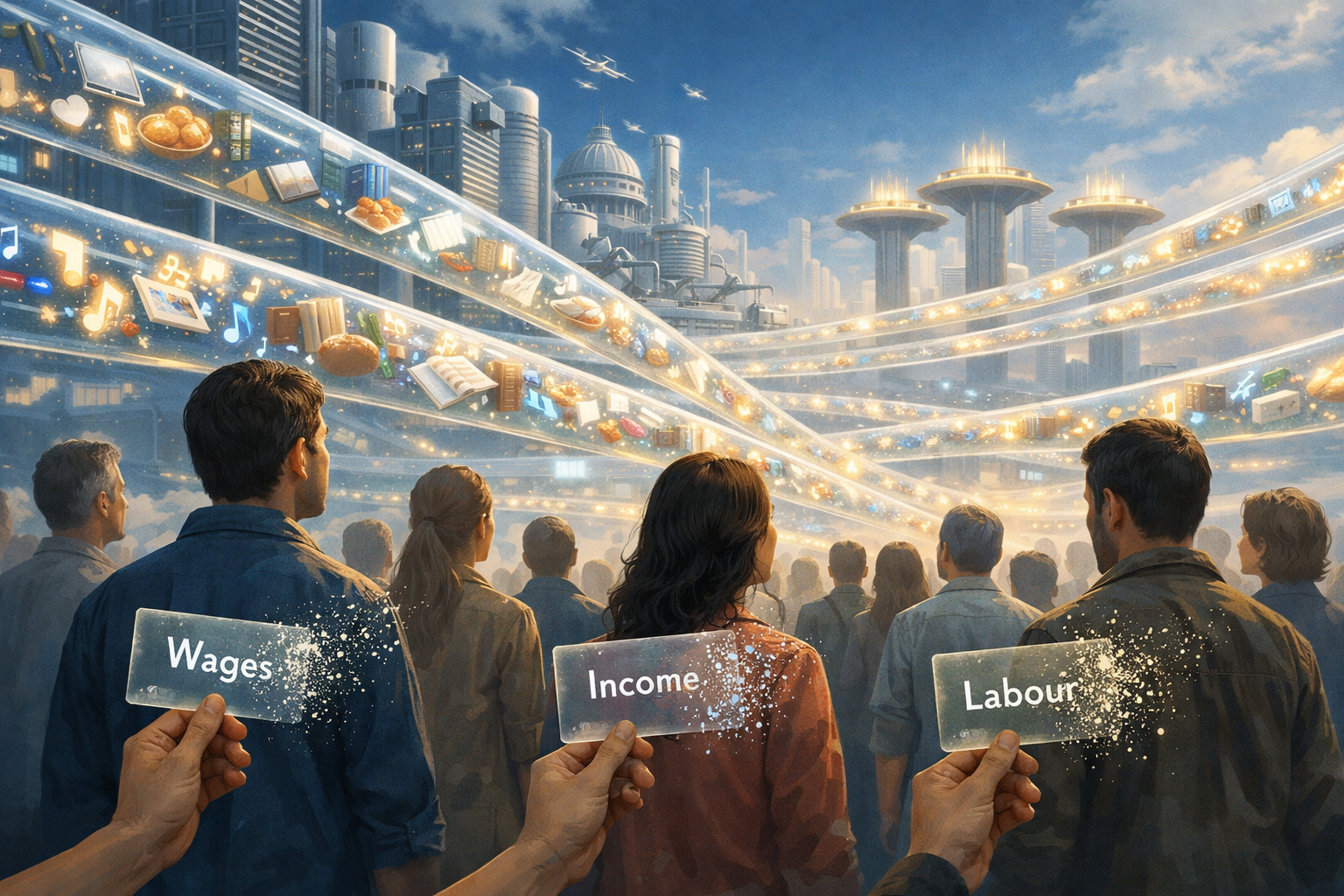
Rifkin was therefore observing a genuine transformation, but only half of one. The decline of marginal costs did change the economics of production, especially wherever information could be copied and distributed digitally. What it did not change was the mechanism society uses to convert production into access. In most cases, this means income. Income is what has always stood between a person and the goods that production makes available. While the abundance of goods may change what exists, it does not always answer the question of who can afford them. Neither does it always answer what a person is paid to earn the right to have it.
The improvement in technology makes this become increasingly impossible to ignore. Take for instance, an industrial robot on an assembly line could replace several factory workers while producing goods more cheaply than ever before. But the workers it replaced did not receive a share of those savings. They lost the wages that had once allowed them to buy the very goods they had helped produce. An AI-powered call centre can now handle in minutes what once required an entire floor of paid agents, often delivering a faster and more consistent service. What disappears is not the service but the income of the people who were once paid to provide it. A freelance illustrator who once earned a living from commissioned work now competes with image-generation systems capable of producing comparable work at almost no cost. Images become more abundant than ever, while the market for the labour that created them steadily contracts.
The pattern is the same in every case. Technology transforms production. Networks accelerate exchange. Platforms expand communication. Yet none of these innovations changes the mechanism through which most people participate in the economy. Access still depends on income, and income still depends primarily on labour. The tools kept evolving. The bridge between people and abundance did not.
A factory town illustrates the paradox. The products it once manufactured may now be cheaper than ever, produced by highly automated facilities employing only a fraction of the previous workforce. Yet lower prices alone do not benefit the people who once depended on those factory wages. They still require income before they can access the abundance automation has created. Production becomes more efficient even as the wage that once connected people to that production becomes less central.
As production required fewer workers, the principal mechanism through which people acquired purchasing power weakened alongside it. Technology expanded society’s productive capacity while leaving access tied to a resource it was increasingly designed to minimise. The economy became better at creating abundance without becoming equally effective at distributing the means to participate in it.
Rifkin’s prediction, then, was not wrong because abundance failed to arrive. It arrived exactly as promised. What failed was the assumption that abundance would naturally produce freedom. That outcome depended on something economists and technologists largely took for granted: that people would continue earning enough income to participate in the economy abundance created. Instead, the very process that drove production costs downward also reduced the amount of labour being purchased. Falling prices and shrinking incomes were never separate trends. They were two expressions of the same underlying transformation.
In earlier industrial revolutions, new technologies displaced some forms of work but eventually created others, allowing most people to exchange their labour for a place within the new economy. The terms were often unequal, but participation remained possible because labour itself retained its central economic role.
Today, the technologies creating unprecedented abundance increasingly require fewer people to operate them. Goods, services, and knowledge continue to multiply, while the mechanism through which most people gain access to them grows weaker. People are not only surrendering their attention to digital systems designed to capture it. Increasingly, they are losing the very means through which attention, effort, and time have historically been converted into economic participation at all.
If technology continues producing more while requiring less of the people it once depended upon, then the defining question of the coming century is whether a civilisation organised around wages can survive its own success, when an increasing number of its own people can no longer afford the returns of that success.