
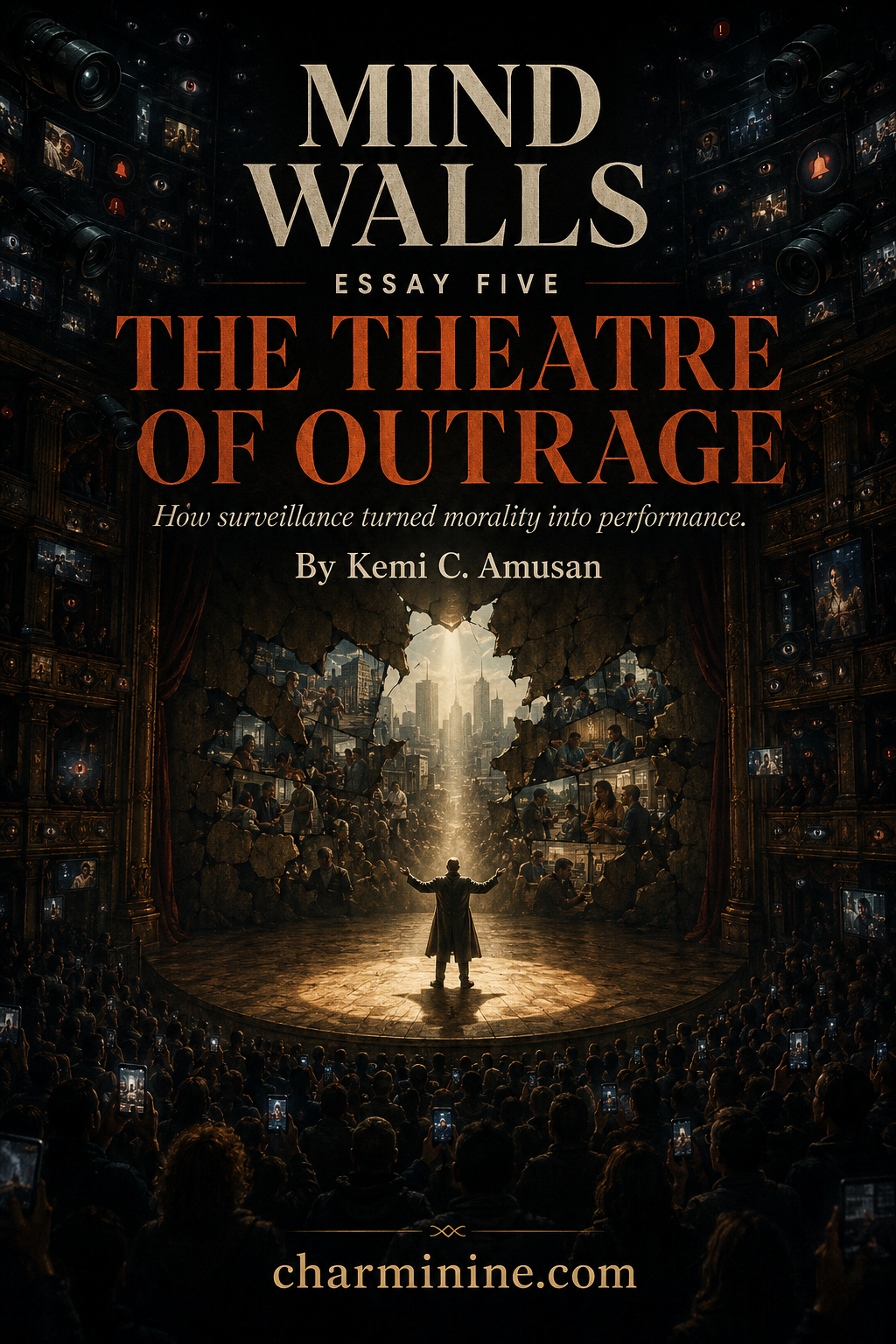
Mind Walls
On Dave Chappelle, Public Soldiers, and Trojan Horses of Disillusionment
By Kemi C. Amusan
Essay Five – The Theatre of Outrage
How surveillance turned morality into performance.
If the previous essay in the series argued that difficult realities arrive like Trojan Horses, this chapter asks a harder question. Why do we fight them so fiercely?
Because something is rewarding us for it.
For a brief moment, outrage relieves us of one of the heaviest burdens of being human: the burden of ambiguity. The world becomes simple. There are heroes to defend, villains to expose, and a script that tells us exactly where we stand. Uncertainty disappears. We know who deserves applause. We know who deserves exile. We know where we belong.
Outrage does something else, too. It gives us identity. Every public act of outrage quietly says, I know who I am. It tells everyone watching that we recognise the moral boundaries of our community and reassures us that we are standing on the right side of them. In a world where identity can feel increasingly unstable, the certainty of condemnation can become strangely comforting.
This relief is not new. It is ancient.
We evolved in small communities where conflict carried real survival weight. Exclusion from the tribe could mean death. Recognising threats mattered. Signalling loyalty mattered. Monitoring the behaviour of others mattered. Communities have always bonded through shared enemies, and nothing unites a crowd more quickly than a common object of condemnation. The scapegoat has been one of humanity’s oldest mechanisms for turning collective anxiety into collective certainty.
Those instincts remain intact. The environment around them has changed completely.
Our nervous systems still respond as though every disagreement threatens the survival of the village, which is why a stranger’s opinion online can trigger an intensity our ancestors might have reserved for an invading army.
The battlefield has gone digital. The biology has not moved.
What has changed is who profits from that biology.
Social media industrialised this instinct.
Algorithms learned that attention follows emotion, and that no emotion holds attention more reliably than moral outrage. The result is one of the most efficient alignments of incentives in modern history. The individual receives visibility. The tribe receives solidarity. The platform receives engagement. News organisations receive traffic. Political movements receive mobilisation. Influencers receive relevance. Even ordinary users receive the brief social recognition that accompanies being seen to stand on the correct side of a controversy.
Everyone gets paid in some currency except reality, which collects nothing and loses the most.
An outraged population is emotionally occupied. It spends enormous amounts of energy fighting symbolic battles while the deeper structures shaping everyday life continue operating almost unnoticed. The more emotionally invested people become in the spectacle, the less attention remains for the slower, less gratifying work of examining those structures.
This is how politics begins to resemble theatre.
Public discourse organises itself around spectacle, one controversy after another, each a fresh episode inviting the audience to choose a protagonist, name a villain, defend the innocent, expose the corrupt, and wait impatiently for the next dramatic twist. The point gradually stops being to understand events. The point becomes staying emotionally invested in them, because that investment is what has commercial value.
Not agreement. Not even happiness. Investment.
It is a remarkably efficient business model because it does not require us to be happy, and it does not even require us to agree. It only requires us to remain emotionally engaged. In fact, the more unhappy we become with the system, and the more willing we are to express that unhappiness publicly, the more valuable our attention can become.
Every refresh, every repost, every angry comment and every triumphant quote becomes another unit of attention converted into economic or social value.
But this economy requires something more than outrage. It requires surveillance.
Foucault described a society in which people learn to regulate themselves because they believe they may be watched. The most powerful form of surveillance, in such a system, is not necessarily the person standing over you. It is the moment you internalise the gaze so completely that you begin monitoring yourself.
Social media has intensified that architecture.
Every timeline becomes a stage. Every profile becomes an identity project. Every audience becomes an invisible jury, already assembled, already primed to cheer at the appropriate volume when someone else violates the code. We no longer simply speak. We calculate, in real time, how our words will be received by people we have never met and may never meet.
We perform ourselves under observation.
And once morality becomes something performed before an audience, condemnation becomes one of the most reliably intoxicating performances available.
Catching someone else’s mistake, an offensive joke, an inconsistent opinion, an old tweet that no longer fits the present moment, gives us the peculiar satisfaction of discovering that someone else has violated the code. By the power vested in us by public condemnation, we take roles once reserved for judges, editors and institutions. We become investigators, prosecutors, juries and executioners in the same gesture.
The emotional reward can be extraordinary.
For a moment, we are not confused. We are not powerless. We are not merely spectators.
We are doing something. We are protecting civilisation itself.
Sometimes we genuinely are. Many abuses deserve public scrutiny. Powerful people should not be shielded from criticism, and genuine injustice should never be waved away in the name of complexity. Public criticism can expose corruption, protect vulnerable people and force institutions to confront failures they would otherwise prefer to hide.
That is precisely why discernment matters.
The danger begins when condemnation itself becomes rewarding.
Once the emotional satisfaction of exposing wrongdoing becomes part of the reward, the search quietly changes. We stop looking only for wrongdoing and start looking for occasions to experience the feeling that exposing wrongdoing gives us. The search for justice becomes entangled with the search for significance. The two can feel almost identical from inside the experience even when they produce entirely different consequences in the world.
And here, reality becomes inconvenient. It really does not cooperate with the theatre.
Reality insists upon contradiction, growth, compromise, inconsistency and change. It insists that institutions can accomplish tremendous good while committing serious failures, that opponents sometimes possess genuine wisdom, and that allies are fully capable of hypocrisy. It refuses permanent heroes and permanent villains because human beings rarely remain either for very long.
Reality is almost always the first casualty of the outrage economy because reality requires context and patience.
Reality asks inconvenient questions precisely when outrage has finally produced satisfying answers.
Every headline contains missing information. Every viral clip has a longer version sitting somewhere just outside the frame. Every public figure occupies a life more complicated than the fifteen seconds through which millions of strangers now claim to understand them. A clip gets lifted from its context. A quote circulates without the conversation that produced it. Thousands of strangers rush to interpret intention before they have finished understanding the words. Positions harden within hours. Demands for denunciation follow. Public silence becomes suspicious. Neutrality becomes impossible.
Everyone is expected to choose a side, not necessarily because choosing a side produces better understanding, but because participation itself has become the entry fee for belonging.
So much so that we seldom stop to ask whether the situation might be more complicated than it first appears.
Reality slows this machine down. It says: I’m not sure yet.
Nothing about the machine wants to hear that. The machine lambasts this patience and calls it cowardice. Punks.
Outrage, meanwhile, wears the costume of courage remarkably well. Because it looks like action, we feel justified. Because it carries the language of morality, we feel righteous. Because other people applaud it, we feel certain.
And so we move faster than human beings are actually capable of understanding.
We confuse being first with being right.
We mistake confidence for competence. We arrive at certainty before the investigation has properly begun.
We arrive at certainty before the investigation has properly begun.
It is easier to repost a slogan than to repair a broken relationship. Easier to cancel a celebrity than to mentor a struggling child. Easier to condemn a comedian than to confront the prejudice quietly living inside our own assumptions.
It is easier, always, to fight a symbolic war than to undertake the slow, frustrating and often invisible work of improving the institutions, communities and relationships that actually shape how people live.
This distinction matters because outrage can produce the feeling of contribution without necessarily producing contribution itself.
There is an enormous difference between outrage that produces accountability and outrage that merely produces the feeling that we have participated in accountability.
One changes the world.
The other changes our emotional state.
From inside the experience, the two can feel almost identical.
They are not.
None of this makes public criticism meaningless. A healthy society cannot survive without criticism, accountability and the willingness to challenge power. The problem begins when the emotional machinery surrounding anger becomes more rewarding than the difficult work of discovering what actually happened and what should be done about it.
A system does not need to be consciously designed to produce this outcome. It only needs outrage to consistently outperform patience, context and uncertainty in the competition for attention. Once that happens, the system begins selecting for outrage.
The machine learns what keeps us watching. And we learn what keeps the machine watching us. That is the deeper trap.
The deeper battlefield is between the mind’s hunger for certainty and a world that keeps offering complexity. Outrage promises relief from that tension. It tells us the story is finished. The verdict has been reached. The enemy has been identified.
Our side is righteous. Very righteous.
Reality quietly whispers that the story is almost never over.
It reminds us that people can be wrong without being evil. That people can be right for the wrong reasons. That institutions can be both useful and corrupt. That opponents can possess wisdom. That allies can be hypocrites. That yesterday’s villain can sometimes become tomorrow’s teacher, and yesterday’s hero can reveal another side of themselves tomorrow.
Reality refuses the clean ending.
And perhaps that is why we love the theatre. Because the theatre gives us something reality cannot.
A script. A role. An enemy. An audience.
And the comforting certainty that we know what happens next.