
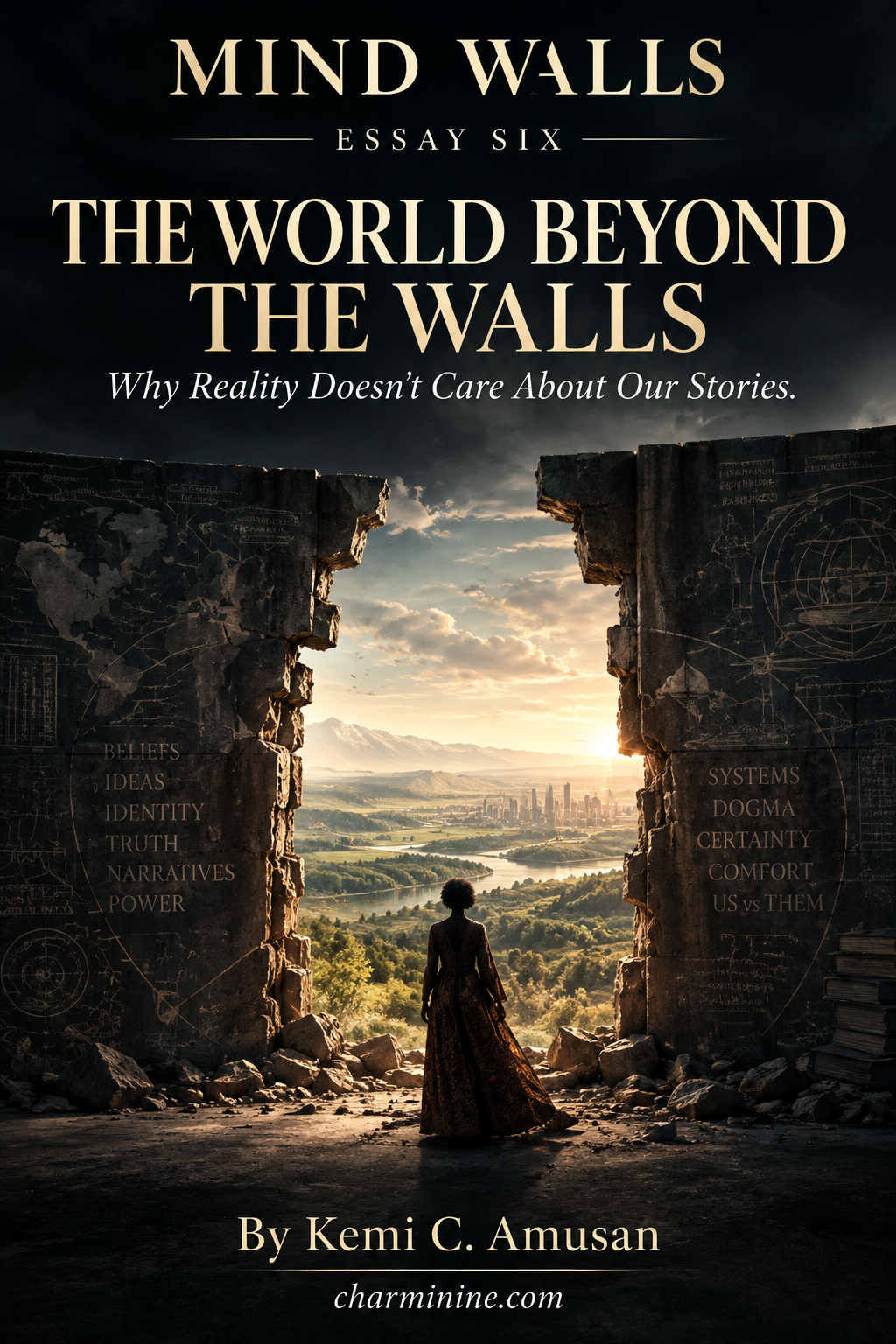
Mind Walls
On Dave Chappelle, Public Soldiers, and Trojan Horses of Disillusionment
By Kemi C. Amusan
Essay Six – The World Beyond the Walls
Why Reality Doesn’t Care About Our Stories
Reality has never granted us the relief of choosing only one value at a time. It insists that justice and mercy coexist, that freedom and responsibility continually restrain each other, that compassion without truth becomes sentimentality and truth without compassion becomes cruelty. It does not ask us to choose one virtue over another. It asks us to become mature enough to hold them together.
More often we discover that the truths we once believed complete were only partial, and we expand rather than replace them. A child learns that rules matter. An adolescent discovers that rules can be unfair. An adult eventually realises that a society without rules becomes unliveable. Each insight corrects the one before it without erasing it. Civilisations seem to grow the same way: not from darkness into light in one leap, but from smaller truths into larger ones.
That is why ideological conflict so rarely resolves. The progressive impulse notices that institutions perpetuate injustice. The conservative impulse notices that institutions preserve hard-won wisdom. The libertarian distrusts concentrated power; the communitarian notices that people do not flourish in isolation. Each perspective illuminates something. Each also casts a shadow. The trouble begins the moment any one of them mistakes itself for the whole landscape.
Reality has resisted every attempt to reduce it to one story. When a theory meets a fact it cannot absorb, we are handed a choice: enlarge the theory, or force the fact back into it. History suggests we usually choose the latter. We redefine words. We move goalposts. We become remarkably creative the moment reality threatens our certainty, because we have confused certainty with strength.
We fall into the quiet arrogance of assuming our present understanding is complete enough that any serious challenge to it must be corruption rather than education.
Yet history repeatedly shows us that sincere, intelligent, morally serious people once defended slavery as natural, monarchy as inevitable, and entire classes of people as destined for servitude. Those convictions were not sustained by stupidity. They were sustained by mind walls – psychological architectures so complete that alternatives became unimaginable. The tragedy was never simply that people believed false things. It is that the false things felt indistinguishable from reality while they believed them.
If people that sincere have repeatedly mistaken their map for the territory, what confidence should we have that we are exempt from the same failure? Which of our own certainties will the next generation inherit with quiet bewilderment? Which walls are we defending today that they will barely notice, because they will have already learned to live beyond them?
None of this is an argument for permanent scepticism. A society incapable of conviction becomes incapable of action. Justice matters. Courage matters. Some ideas deserve resistance and some boundaries deserve defending. The aim is to hold enough humility to know the difference.