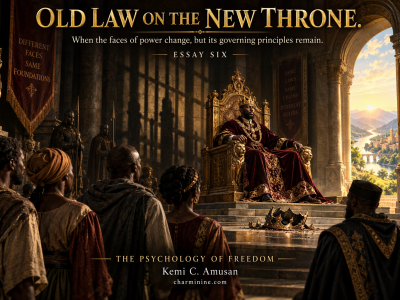
OLD LAW ON THE NEW THRONE depicts a grand medieval throne room rendered in a cinematic Renaissance-inspired style. At the center-right, a newly crowned Black ruler sits with dignity upon an imposing golden throne, dressed in deep burgundy velvet adorned with antique gold embroidery and wearing an ornate crown. At the foot of the throne lies a shattered crown, symbolizing the fallen order. In the foreground, Black men and women from different walks of life stand facing the ruler, emphasizing the relationship between political power and those who live under it. Behind the throne, elongated shadows stretch across ancient stone walls, forming prison-bar patterns that suggest the persistence of oppressive structures despite a change in leadership. To the far right, a majestic archway opens onto a bright, sunlit landscape, representing the possibility of a different social order. Rich tones of antique gold, burgundy, bronze, charcoal, and warm ivory create a regal yet unsettling atmosphere. The cover includes the title OLD LAW ON THE NEW THRONE, the subtitle “When the faces of power change, but its governing principles remain.”, ESSAY SIX, and the branding THE PSYCHOLOGY OF FREEDOM • Kemi C. Amusan • charminine.com.

The Psychology of Freedom Captivity, Conditioning, Healing and Power By Kemi C. Amusan Charminine.com ESSAY SIX OLD LAW ON THE NEW THRONE

Liberation changes where a person stands without necessarily changing what they believe power is. The former servant may become the lord, the excluded may become the gatekeeper, and the once-oppressed may reproduce the very conditions they fought to escape. This essay examines the psychological inheritance of oppression, the wounds that survive success, and the danger of carrying old laws into new positions of authority. It argues that genuine liberation requires two disciplines: inner healing that changes how we understand and exercise power, and external structures that hold power accountable when personal insight fails. For freedom to endure, power must become an instrument of stewardship rather than a means of securing the helplessness of others.

The Psychology of Freedom By Kemi C. Amusan ESSAY THREE   The Garlic of Egypt: Deconditioning and the Loneliness of the Pioneer

ESSAY SERIES The Psychology of Freedom By Kemi C. Amusan Charminine.com ESSAY THREE   The Garlic of Egypt: Deconditioning and the Loneliness of the Pioneer   The Price of Refusing the Role Laws may be changed, institutions remade, and the distribution of resources altered, yet the mind can remain loyal … More The Psychology of Freedom By Kemi C. Amusan ESSAY THREE   The Garlic of Egypt: Deconditioning and the Loneliness of the Pioneer »

The Measure of Aliveness Kemi C. Amusan Essay 2 What Is Aliveness?

      The Measure of Aliveness   Kemi C. Amusan   Essay 2 What Is Aliveness?   Essay 1 ended with a question left deliberately open: what determines whether a person is simply existing inside a sequence of years, or actually participating in the life those years contain? We … More The Measure of Aliveness Kemi C. Amusan Essay 2 What Is Aliveness? »

The Measure of Aliveness Kemi C. Amusan Essay 1 Are we running out of time, or out of life?

    The Measure of Aliveness Kemi C. Amusan Essay 1 Are we running out of time, or out of life? We have been taught to think of life in units of time. Years, months, weeks, days. We celebrate birthdays because another year has passed. We measure careers by how … More The Measure of Aliveness Kemi C. Amusan Essay 1 Are we running out of time, or out of life? »

Mind Walls On Dave Chappelle, Public Soldiers, and Trojan Horses of Disillusionment By Kemi C. Amusan Essay Seven -Sovereignty Growing beyond public soldiers and reclaiming the governance of the inner country.

Mind Walls On Dave Chappelle, Public Soldiers, and Trojan Horses of Disillusionment By Kemi C. Amusan Essay Seven –Sovereignty Growing beyond public soldiers and reclaiming the governance of the inner country. It is fashionably cynical to mistake demolition for wisdom, as though the person who believes in the fewest things … More Mind Walls On Dave Chappelle, Public Soldiers, and Trojan Horses of Disillusionment By Kemi C. Amusan Essay Seven -Sovereignty Growing beyond public soldiers and reclaiming the governance of the inner country. »

Mind Walls On Dave Chappelle, Public Soldiers, and Trojan Horses of Disillusionment By Kemi C. Amusan Essay Three: Mind Walls What We Mistake for Reality.

  Mind Walls On Dave Chappelle, Public Soldiers, and Trojan Horses of Disillusionment By Kemi C. Amusan   Essay Three: Mind Walls What We Mistake for Reality. Every country has borders. It has a constitution, a history, trusted institutions, allies, enemies, myths, heroes and monuments. It has places that feel … More Mind Walls On Dave Chappelle, Public Soldiers, and Trojan Horses of Disillusionment By Kemi C. Amusan Essay Three: Mind Walls What We Mistake for Reality. »

Unpacking Rose’s Heroine’s Journey in Titanic: An Introduction to the Transformative Odyssey

  By: Kemi C. Amusan   Maureen Murdock’s exploration of the Heroine’s Journey reveals a transformative path, where women often separate from their feminine principle to align with the masculine principle, pursuing success defined by traditional masculine norms. However, this alignment ultimately proves inadequate, leaving a sense of emptiness. To … More Unpacking Rose’s Heroine’s Journey in Titanic: An Introduction to the Transformative Odyssey »

The Trickster Shrink in Afterlife: A Jungian Analysis of the Unorthodox Therapist

The Trickster Shrink in Afterlife: A Jungian Analysis of the Unorthodox Therapist By Kemi Amusan   The Shrink as Trickster Meet Tony and Matt’s unorthodox shrink in Afterlife. (played by Paul Kayes) A Trickster archetype with a penchant for pushing boundaries and a few unresolved issues of his own. This … More The Trickster Shrink in Afterlife: A Jungian Analysis of the Unorthodox Therapist »

Follow us on Social Media