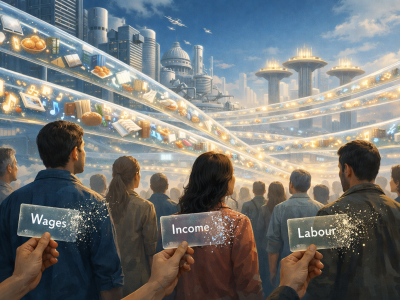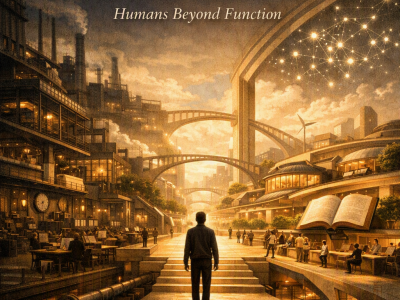
Humans Beyond Function Redesigning Access to Life When Machines Do the Work Kemi C. Amusan Essay VI The Architecture of Access

What if the next great expansion of human prosperity depends less on producing ever more, and increasingly on becoming extraordinarily sophisticated at connecting people to the value civilization has already created? Google organized access to knowledge. Spotify reorganized access to music. Wikipedia transformed participation into collective intelligence. Open source turned distributed contribution into technological infrastructure. Artificial intelligence is now making expertise increasingly accessible. Even the humble biodigester reveals the same principle by transforming overlooked organic waste into energy and agricultural inputs. Across these seemingly unrelated innovations lies a common pattern: narrowing the distance between existing value and human participation. Production built the modern world. Access may determine who is ultimately able to inhabit it.
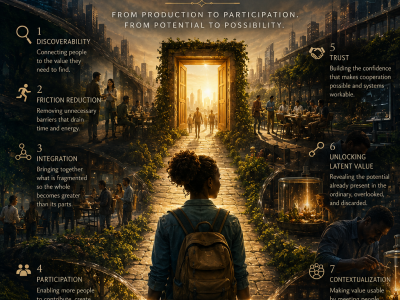
Humans Beyond Function Redesigning Access to Life When Machines Do the Work Kemi C. Amusan Essay V The Age of Access

Industrial civilization became remarkably skilled at creating value. The next civilization may be judged by something different: how effectively it enables people to reach, use, and participate in the value civilization has already created. Access is not a philosophy of sameness or redistribution. It is a philosophy of possibility, concerned with the barriers that separate human potential from the conditions through which that potential can become useful.

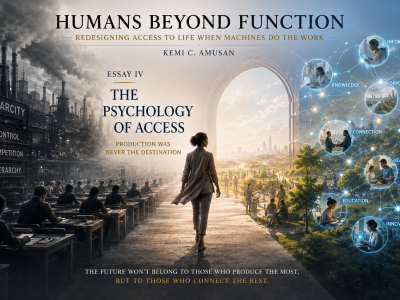
Editorial cover image for Humans Beyond Function: Redesigning Access to Life When Machines Do the Work, Essay IV, The Psychology of Access, by Kemi C. Amusan. A woman walks from a dark industrial landscape marked “Scarcity,” “Control,” “Competition,” and “Hierarchy” toward a bright, connected future representing information, knowledge, opportunity, connection, healthcare, education, and innovation. The image includes the phrase “Production Was Never the Destination.”

Humans Beyond Function Redesigning Access to Life When Machines Do the Work Kemi C. Amusan ESSAY IV The Psychology of Access

As machines become increasingly capable of producing what humanity needs, the central challenge of civilization may no longer be production—but access. The next great transformation will depend on how effectively we connect people to the knowledge, opportunities, institutions, technologies, and resources that already exist. This is not simply an economic transition. It is a psychological one: from a civilization shaped by scarcity, control, and accumulation toward one increasingly organized around connection, participation, and reduced friction.

Humans Beyond Function Redesigning Access to Life When Machines Do the Work By Kemi C. Amusan   Essay I The Zero Marginal Cost Society and the Broken Prediction The Shadow Side of Technological Democratization

  Humans Beyond Function Redesigning Access to Life When Machines Do the Work By Kemi C. Amusan   Essay I The Zero Marginal Cost Society and the Broken Prediction The Shadow Side of Technological Democratization Jeremy Rifkin thought he had seen the future. Writing in The Zero Marginal Cost Society … More Humans Beyond Function Redesigning Access to Life When Machines Do the Work By Kemi C. Amusan   Essay I The Zero Marginal Cost Society and the Broken Prediction The Shadow Side of Technological Democratization »

Follow us on Social Media