
The Revolt of the Cat Ladies
Kemi C. Amusan
Chapter 1: Election Night
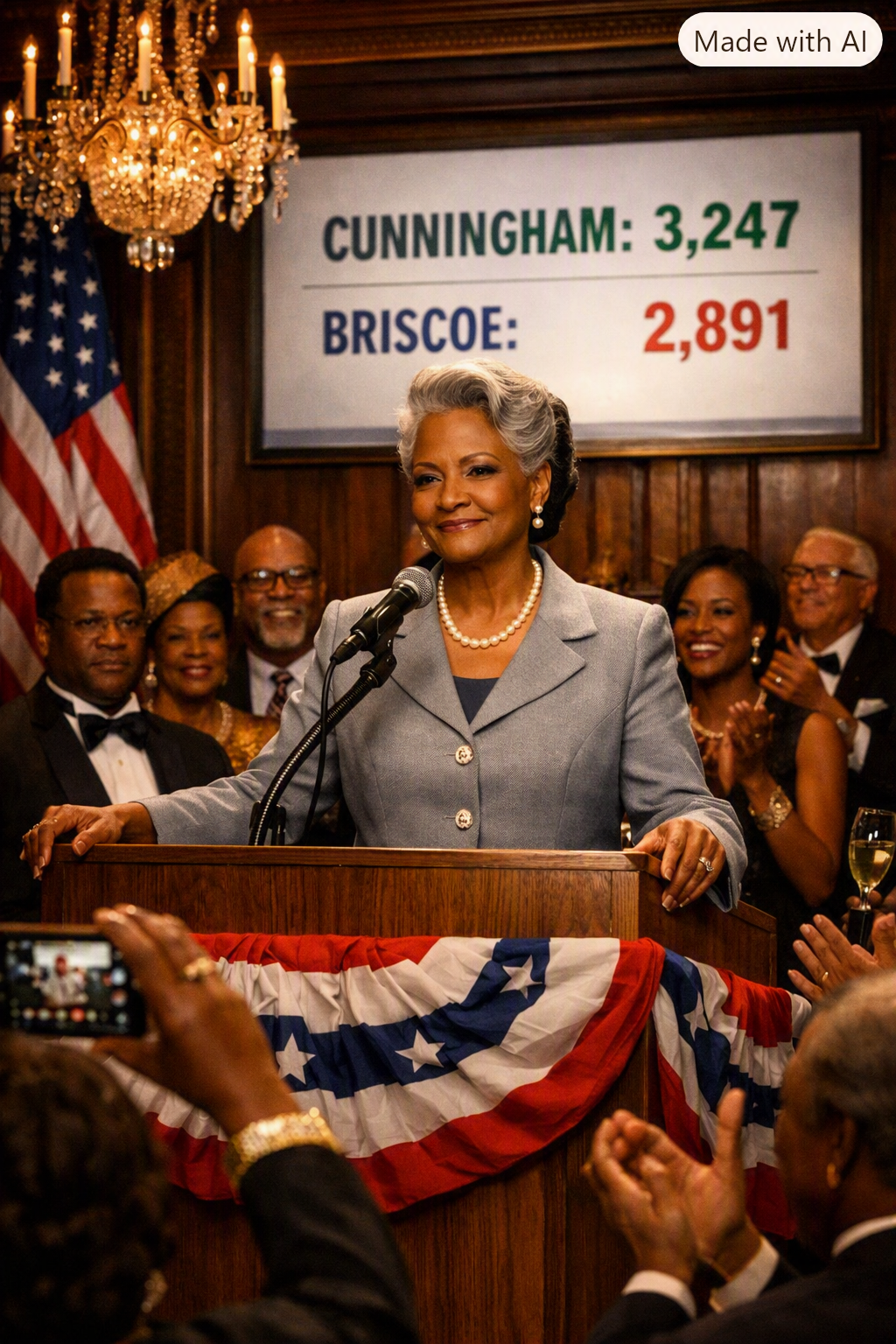
The votes came in just after nine o’clock, and by nine-fifteen, the fellowship hall at First Baptist had gone silent in a way that made Dorothy Cunningham smile.
She stood at the front of the room in a dove-gray suit with pearl buttons, her silver hair swept into a French twist, hands folded neatly at her waist. Around her, the cream of Emberhill society: lawyers, doctors, business owners, all of them dressed like they were attending someone’s wedding, stared at the projection screen as if it had just announced the end of the world.
CUNNINGHAM: 3,247
BRISCOE: 2,891
Dale Briscoe sat in the third row, jaw working like he was chewing glass. His campaign manager, a sweaty man named Dennis, leaned over and whispered something urgent. Dale waved him off.
Dorothy let the silence stretch. She’d learned, over sixty-eight years, that silence made men uncomfortable in ways that shouting never could.
Finally, she stepped up to the microphone. The feedback whined, then settled.
“Good evening, Emberhill.”
Her voice was measured, elegant, the voice of a woman who’d gone to Spelman in 1975 and never once regretted it.
“I want to thank everyone who came out tonight. This has been a hard-fought campaign, and I have nothing but respect for Mr. Briscoe and his team.”
Dale’s mouth twitched. Respect. Sure.
Dorothy continued, her tone smooth as Sunday morning. “I know some of you are surprised. Maybe even disappointed. But I want you to know that I take this responsibility seriously. Emberhill is my home. It’s been my home for forty years. And I intend to serve every single one of you, whether you voted for me or not, with integrity, with dignity, and with the kind of leadership this town deserves.”
Polite applause. Scattered, uncertain.
And then Dorothy smiled, just a little, and her voice shifted. Not much. Just enough.
“And to Mr. Briscoe…” She paused, let the room lean in. “Baby, you tried it.”
The room exploded.
Half the people gasped. A quarter laughed—sharp, shocked laughter. A few of the younger women in the back actually clapped. Dale’s face went red, then purple. He stood up so fast his chair scraped the floor.
“This is a disgrace,” he said, voice shaking. “Y’all really gonna let this…this crazy cat lady…run this town? Y’all seen her house? She got more cats than sense. Probably talks to ’em at night. Probably thinks they talk back.”
Someone snickered. Dale wheeled on them.
“Laugh all you want. But don’t come crying to me when she starts making decisions based on what her cats think.”
Dorothy didn’t move. Just stood there, hands folded, that small smile still on her face.
Dale grabbed his coat. “I’m done. Y’all made your choice. Enjoy it.”
He stormed out. His crew followed, muttering. The door slammed.
Dorothy waited until the sound faded. Then she turned back to the microphone.
“Shall we move on to the swearing-in?”
The victory party was at Dorothy’s antique shop on Main Street, a narrow brick building wedged between the post office and a bakery that had been closed for three years. The sign above the door read Cunningham & Co. Fine Antiques in gold lettering, and the windows were full of things that made you feel like you’d stepped into someone’s grandmother’s attic: church fans, Jet magazines from the sixties, vintage Ebony covers, carved walking sticks, quilts.
Inside, the air smelled like lemon polish and old paper. About thirty people had squeezed into the front room, most of them women, most of them holding plastic cups of wine from the box Dorothy kept in the back office.
Emma Hartley stood near the register, trying not to stare at the framed photograph of Dorothy shaking hands with someone who might have been John Lewis. She’d voted for Dorothy, quietly, without telling anyone except her mother, and now she felt something she couldn’t quite name. Pride, maybe. Or hope.
“Emma!”
She turned. Linda Marshall was waving at her from across the room, a cup of wine in each hand. Linda was in her mid-forties, divorced, worked from home doing something with editing. She wore jeans and a sweater that looked expensive but comfortable, and her locs were pulled back in a loose bun.
“Girl, you see Dale’s face?” Linda said, handing Emma one of the cups. “I thought he was gonna have a stroke right there in the fellowship hall.”
Emma laughed despite herself. “It was pretty bad.”
“Bad? It was beautiful.” Linda took a sip. “That man’s been running this town like his personal playground for twenty years. It’s about time somebody checked him.”
“I just hope she can actually do something,” Emma said. “You know how they are. The council’s all men except for Mrs. Patterson, and she barely says anything.”
“Dorothy’s not Mrs. Patterson.” Linda gestured toward the back of the shop, where Dorothy was talking to a small group of women near a display of vintage hats. “That woman don’t play.”
Emma sipped her wine. It was sweet, a little too sweet, but she didn’t mind. Across the room, Dorothy laughed. A real laugh, not the polite one she’d used at the fellowship hall—and the women around her laughed too.
“You think it’ll change anything?” Emma asked.
Linda shrugged. “Maybe. Maybe not. But at least we tried.”
The Christmas tree lighting was at eight.
Emma stood in the town square with Colin, her hand tucked into the crook of his elbow. He was wearing a wool coat over his suit, and he smelled like cologne and the peppermint gum he was always chewing. Around them, families clustered on the lawn, kids running in circles, parents shouting half-hearted warnings.
The tree was a thirty-foot spruce donated every year by the Morgans, who owned the tree farm out on Route 9. It stood in the center of the square, unlit, surrounded by wooden nativity figures that looked like they’d been carved in 1952 and never replaced.
Mayor Briscoe, former mayor, Emma reminded herself, usually did the honors. This year, Dorothy would flip the switch.
Colin leaned close. “You cold?”
“A little.”
He pulled her closer. “Won’t be long now.”
Emma nodded, but she wasn’t really listening. She was watching the crowd. Her father was across the square with a group of men from the Rotary Club—Robert Hartley, fifty-six, owner of Hartley Hardware and Building Supply, a man who wore a tie even on Saturdays. He was talking to someone, but his eyes kept drifting toward the platform where Dorothy stood.
Her mother, Grace, was near the church steps with a few other women from the choir. She looked tired. She always looked tired lately.
“Ladies and gentlemen,” Dorothy’s voice crackled over the PA system. “Thank you for coming out tonight. It’s a blessing to be here with you all as we kick off the Christmas season.”
Applause. Warmer than at the fellowship hall.
“This is my first official act as mayor,” Dorothy continued, “and I couldn’t think of a better one. So without further ado…”
The tree lit up. White lights, thousands of them, spiralling from the base to the star at the top. The crowd clapped. A few kids cheered.
And then Colin was pulling Emma toward the platform.
“What are you…”
“Come on,” he said, grinning.
He led her through the crowd, past families and old ladies with their purses clutched tight, until they were standing at the base of the tree. The lights cast everything in white and shadow.
Colin turned to face her. He was still grinning, but there was something nervous in his eyes now.
“Emma Hartley,” he said, loud enough that people nearby turned to look. “I’ve known you my whole life. Went to school with you. Sat behind you in church. And I’ve been trying to work up the courage to do this for the last six months.”
Emma’s stomach dropped.
“Colin…”
He dropped to one knee.
The crowd went silent.
“Will you marry me?”
He pulled a ring from his pocket, small, silver, a single diamond that caught the light.
Emma’s heart was pounding. She could feel everyone watching. Her father. Her mother. Dorothy Cunningham, still standing on the platform. Linda Marshall, somewhere in the crowd.
Colin looked up at her, still grinning, still confident.
And Emma heard herself say, “Yes.”
The crowd erupted. Colin stood, slid the ring onto her finger, kissed her. People clapped. Someone whistled.
Emma smiled. She was supposed to be happy. She was happy.
Wasn’t she?
Across the square, Robert Hartley watched his daughter kiss Colin Barrett and felt his jaw tighten.
He knew that boy. Not personally—not well—but he knew the type. Fast-talking, charming, always got an angle. The kind of man who made promises he had no intention of keeping.
Robert had been that man once.
He turned away, hands in his pockets, and walked toward his car.
Behind him, the Christmas lights glittered like teeth.