
Michael Jackson and the Billion Dollar Verdict
In the Court of Public Opinion
By Kemi C. Amusan
Three numbers.
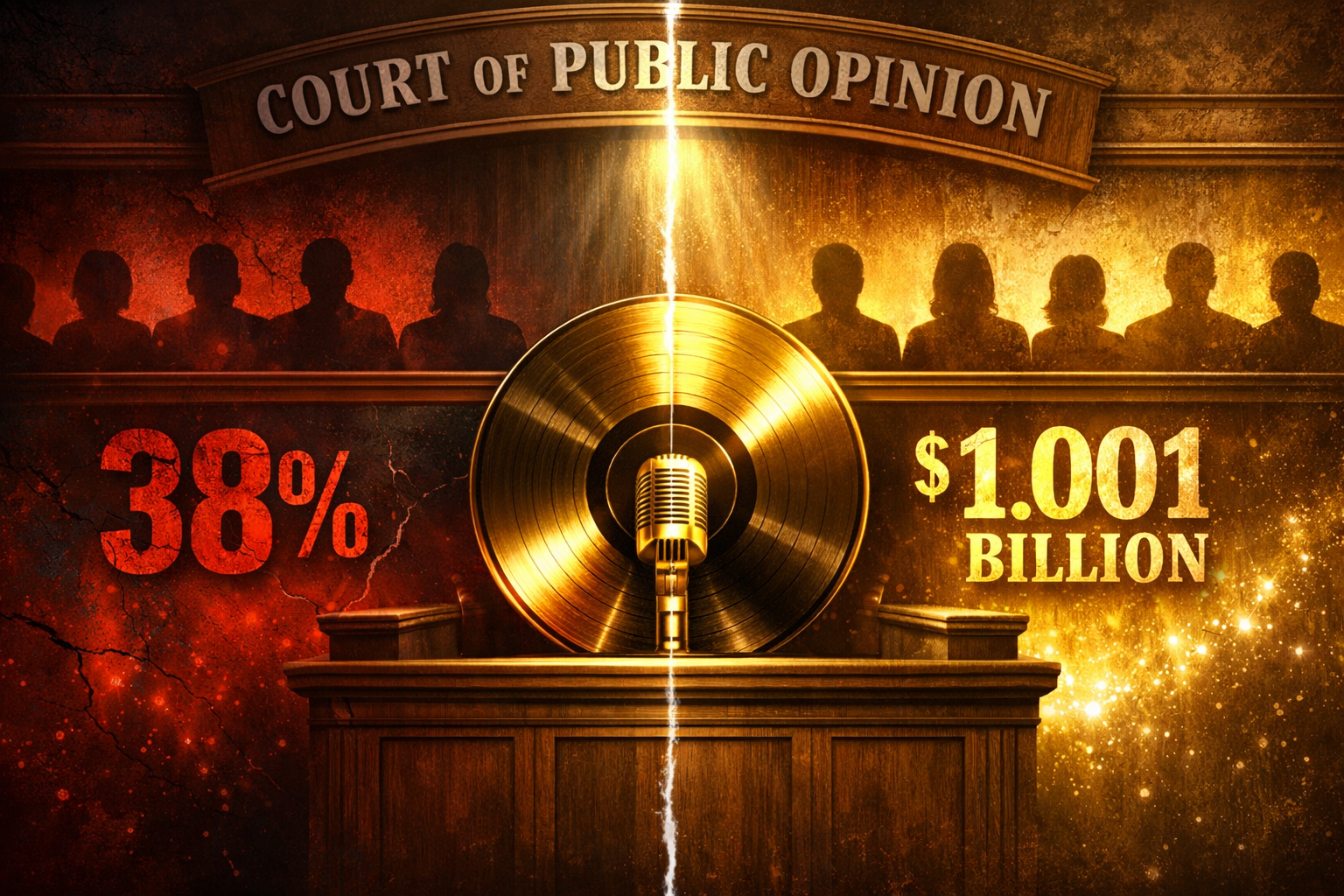
$1.001 billion at the global box office as of July 13, 2026. The first biopic in cinema history to cross that threshold.
38%. The critics’ score on Rotten Tomatoes for the same film.
105 million. Michael Jackson’s monthly Spotify listeners after the film’s release, up from 68 million before it.
The gap between 38% and a billion dollars is not a curiosity. It is a verdict. It is millions of people around the world sitting in the same cultural moment, looking at the same man’s story, and reaching a conclusion the institutional arbiters of public opinion did not sanction, did not predict, and cannot explain away.
This is about that gap.
About what that gap reveals about power, narrative, and the growing refusal of ordinary people to let institutions do their thinking for them.
Because the court of public opinion just delivered a ruling. And the question worth asking is how that court works, who has been controlling it, and what it means that so many people are finally taking their seat as jury.
The Anatomy of the Permanent Asterisk
A reputation does not require a conviction to be destroyed. It requires a question mark installed in the right place, repeated through the right channels, until it becomes indistinguishable from fact.
This is narrative assassination. And its most sophisticated feature is that it does not need false information to function. It needs a machinery.
Architecture means selection. What gets included and what gets left out. What receives emphasis and what receives a footnote. What arrives first in the sequence and what arrives after the impression has already formed. A documentary does not need to fabricate events to shape a conclusion. A headline does not need to lie to guide interpretation. A phrase like “complex legacy” does not need to prove anything. It only needs to travel.
Repeated enough times, across enough platforms, through enough voices, suspicion becomes established fact. The question mark becomes the verdict.
The most powerful reputational damage is not always created through a proven statement. It is created through an unresolved association that follows someone indefinitely.
This is the permanent asterisk. The person stops being evaluated by the totality of their life and work. They become the person who was accused. The person surrounded by controversy. The person whose legacy raises questions. The language sounds balanced. It presents itself as nuance. But language does not merely describe reality. Language organizes reality. And when one organization of reality is repeated consistently enough through trusted institutional channels, the public stops experiencing it as a frame. They experience it as the picture itself.
They do not remember receiving an interpretation.
They remember knowing something.
The first frame is the most powerful frame. The human mind is not designed to investigate every claim from first principles. It uses shortcuts. It categorizes. It looks for patterns. And the pattern that arrives first tends to shape everything that follows. Achievements become contradictions. Explanations become excuses. Evidence is interpreted through the conclusion already forming.
The person is no longer being evaluated.
The person is being interpreted.
Michael Jackson lived inside this mechanism for decades. The creativity was undeniable. The cultural impact was undeniable. The personal life was unconventional, and unconventionality creates a space where interpretation becomes contested. That contested space was where the architecture was built. Not through a single event but through the accumulation of frames, sequences, and emphases that gradually became the dominant story about who he was.
The question this essay is asking is not whether the dominant story was true.
The question is who built it.
Who Builds the Narrative and Why
Stories do not simply appear. Someone decides what is included. Someone decides what is emphasized. Someone decides the sequence in which information arrives. Someone decides which witnesses speak longest, which images appear most often, which moments define the whole.
This does not require a conspiracy. Systems produce outcomes through incentives rather than central coordination. Media organizations compete for attention. Audiences respond to emotional intensity. Controversy generates engagement. A dramatic conflict travels faster than a complicated reality. The result is a world where complexity consistently struggles against simplicity, and where the loudest interpretation can become stronger than the most carefully examined one.
But sometimes the production process has a name.
The 2003 documentary that triggered the criminal proceedings against Michael Jackson was produced by James Goldston for Granada Television. It aired in February 2003. The presentation was constructed around a specific set of editorial choices. Jackson’s own team released counter-footage demonstrating how extensively the broadcast had been shaped through selection and emphasis. Within months of the documentary’s broadcast, Jackson was under criminal investigation.
The 2026 Netflix documentary revisiting those same proceedings, released within weeks of the biopic crossing a billion dollars, was also executive produced by James Goldston.
Same producer. Same subject. Two decades apart.
The question is not whether either documentary was fair. The question is whether the public knows to ask who built the narrative before deciding what the narrative means.
The legal record is instructive here. In 2005, following one of the most scrutinized criminal trials of the modern era, a jury of twelve ordinary people deliberated after fourteen weeks of testimony and returned a verdict of not guilty on all counts. Those jurors examined the evidence. They evaluated credibility under cross-examination. They heard the full record, not a documentary edit. The prosecution brought forward 85 witnesses. The defence responded.
The jury’s conclusion was unambiguous.
The institutional narrative that survived the acquittal was not built on the legal record. It was built on the architecture surrounding it. On the impression created before the trial began. On the language chosen to describe the outcome afterward. On the permanent question mark that certain institutional voices maintained after the verdict rather than reporting it as the clear legal finding it was.
There is also the matter of what Michael Jackson owned. At the time of his death, Jackson held significant rights in one of the most valuable music publishing catalogs in history. The financial interests surrounding that asset were considerable. These facts do not constitute a conclusion about what happened. They constitute a question the public deserves to hold alongside every institutional narrative constructed around him.
Who benefits from this conclusion?
That question does not mean every institution operates in bad faith. It means institutional narratives are never produced in a vacuum. They are produced by people with careers, incentives, relationships, and interests. Those interests shape the framing before the audience ever encounters the information. Knowing this is the beginning of honest evaluation.
The Consequences of Outsourcing Your Verdict
Narrative is never neutral.
Every story that arrives through an institutional channel was constructed by someone with an interest in your conclusion. The question is never only what happened. The question is who decided what happened means, and what they needed you to believe as a result.
When a person outsources their moral judgment they do not become objective. They become a tool. They carry someone else’s conclusion as their own perception. They repeat it. They defend it against evidence because it has become identity. They experience it as knowledge when it is actually familiarity.
Familiarity is not knowledge. It is exposure to the same interpretation repeated until it feels self-evident.
The human brain often mistakes repetition for certainty. A statement encountered consistently begins to feel established, even when the underlying evidence remains contested. A person may say “everyone knows what happened” when what they actually mean is “I have encountered the same interpretation many times.” Those are different experiences. One is knowledge. The other is a borrowed conclusion wearing knowledge’s clothes.
The consequences of this outsourcing extend far beyond any single person’s story.
A society that cannot examine the production process of its own narratives can be managed through narrative indefinitely. The technology of narrative construction is not staying still. What was done through a single documentary in 2003 is now done at scale, at speed, across every platform simultaneously. Algorithms organize the sequence in which information arrives. Search systems weight certain sources over others. AI summaries compress contested realities into confident-sounding conclusions. The distance between an event and public understanding continues to expand.
The person who controls the frame increasingly controls the conclusion.
This is not a problem contained to one musician’s reputation. It is the defining challenge of modern public life. The same mechanism that can unjustly destroy one person’s legacy can also shield another from accountability. A society that abandons careful evaluation simply becomes more vulnerable to whichever narrative gains the most institutional support.
The next person to be narratively assassinated will not have a billion-dollar vindication waiting. They will be someone smaller, less resourced, without decades of documented work to anchor the counter-narrative. And if the public has not developed the habit of sovereign judgment, the machinery will work exactly as designed.
The consequence of not reclaiming the verdict is not only that one person’s story gets distorted but that the machinery grows more confident.
The Billion Dollar Answer
On July 12, 2026, the Michael Jackson biopic crossed $1.001 billion at the global box office.
It became the first biopic in cinema history to reach that milestone. It became the highest-grossing musical biopic ever made, surpassing Bohemian Rhapsody. It was Lionsgate’s first billion-dollar film in the studio’s history. The critics gave it 38% on Rotten Tomatoes. The audience gave it a billion dollars.
That gap is the most precise measurement available of what happens when people exercise sovereign judgment at scale.
No single institution organized the public’s response. No coordinating body told millions of people across different continents, languages, and cultural contexts to go to the cinema. People went because they had a relationship with the work that no narrative had fully severed. Because the music existed independently of the architecture built around the man. Because when they encountered the story directly, without the documentary frame arriving first, they trusted what they felt over what they had been told to feel.
When the Netflix documentary arrived within weeks of the billion-dollar crossing, fans responded without coordination and without a manifesto. They flooded social platforms with a single image: Michael Jackson entering the courthouse in 2005, dressed in white and gold, flanked by his family, walking without apology into the building where his innocence would be confirmed. No argument. No rebuttal. Just the image.
Not because it settled any legal question. Because it communicated something the framing had tried for two decades to obscure.
The court of public opinion had been running for twenty years. In 2026 it delivered its finding in the only language institutions cannot edit: money, music, and a billion acts of sovereign choice.
The fans who spent years reading trial transcripts, cross-referencing timelines, tracing production histories, and distributing counter-evidence were not simply defending a celebrity. They were building the infrastructure of independent evaluation before it had a name. They were practicing epistemic sovereignty in real time. And when the biopic arrived and the counter-documentary followed, that infrastructure was already in place.
The institutional narrative lost the information war. Not because it was outspent. Because the public stopped cooperating with it.
The Tools of Sovereign Judgment
The court of public opinion is not a mob when it functions correctly. At its sovereign best, it is millions of people exercising independent judgment simultaneously and arriving at truth the institutions could not afford to deliver.
But it requires tools. Not cynicism. Not the blanket rejection of every institutional voice. Specific, learnable habits of evaluation that anyone can develop.
Ask who produced it before you decide what it means. A documentary, an article, a summary, a platform recommendation is not a neutral delivery system. It was built by someone with a career, incentives, and relationships. Those factors shape the mechanism before the information reaches you. Knowing who built something does not tell you it is false. It tells you what questions to ask.
Follow the production history, not just the content. The same producer working on the same subject across two decades is a fact worth knowing before you receive their second version of the story. The financial interests surrounding a public figure’s assets are facts worth knowing before you accept the narrative constructed around their life. These do not constitute conclusions. They constitute the context that allows honest evaluation of the conclusion being offered.
Distinguish between legal judgment and narrative judgment. A courtroom asks whether guilt has been proven according to a defined legal standard, with rules of evidence, cross-examination, and a burden of proof. The court of public opinion often asks whether there is enough suspicion for a person to be permanently marked. Those are different systems with different standards and different implications. Knowing which system is operating on you is the beginning of sovereign judgment.
Recognise the language of managed uncertainty. Phrases like “complex legacy,” “lingering questions,” and “raises concerns” are not neutral descriptions. They are framing choices. They maintain a question mark where a conclusion should be. When you encounter them, ask what work that language is doing and who benefits from the uncertainty remaining unresolved.
Trust your direct experience before the commentary arrives. The 38% existed before most people saw the film. A person who read the critics first and then watched experienced something different from a person who watched first and then encountered the critics. The sequence matters. Your unmediated response to a piece of work, a person, or an event is data. It deserves weight before institutional interpretation has organized it into something more manageable.
Read primary sources when the stakes are high. Trial transcripts exist. Financial records are public. Timelines can be reconstructed. The distance between a summary and the primary source is where the framing lives. You do not need to become an investigative journalist for every story you encounter. But for the narratives being used to shape your permanent conclusions about a person, the primary source is worth the effort.
The court of public opinion has always existed. Every era has its judges. Every era has its verdicts. The only thing that changes is who controls the courtroom.
For most of modern history, controlling the courtroom meant controlling the printing press, the broadcast signal, the documentary commission, the distribution platform, and eventually the algorithm. That control shaped what the public knew, in what order they knew it, and how they were invited to feel about it.
That control has not disappeared. But it has been contested.
A billion dollars is a contest. 105 million monthly listeners is a contest. A white and gold image moving across every platform without a single coordinating body is a contest. It is not a perfect system. Public opinion can be wrong. Crowds can be manipulated. The tools of sovereign judgment are not a guarantee of truth.
But they are the alternative to a world where institutions deliver the verdict and the public simply receives it.
We are always in a court of public opinion about something. A person, an institution, a movement, an idea. Someone is always constructing the case. The information is always arriving through a frame we did not build and may never fully see.
The only question is whether we are the jury exercising sovereign judgment.
Or the verdict someone else already wrote.
Michael Jackson and the Billion Dollar Verdict is a Systems essay published by Charminine Studios. It is part of an ongoing body of work examining how narratives are constructed, how institutions shape public perception, and what it means to think for yourself in an age of managed information.