
The Exhausted Civilization
Why Modern Life Has Forgotten How Living Systems Work
By Oluwakemi C. Amusan
Chapter Two
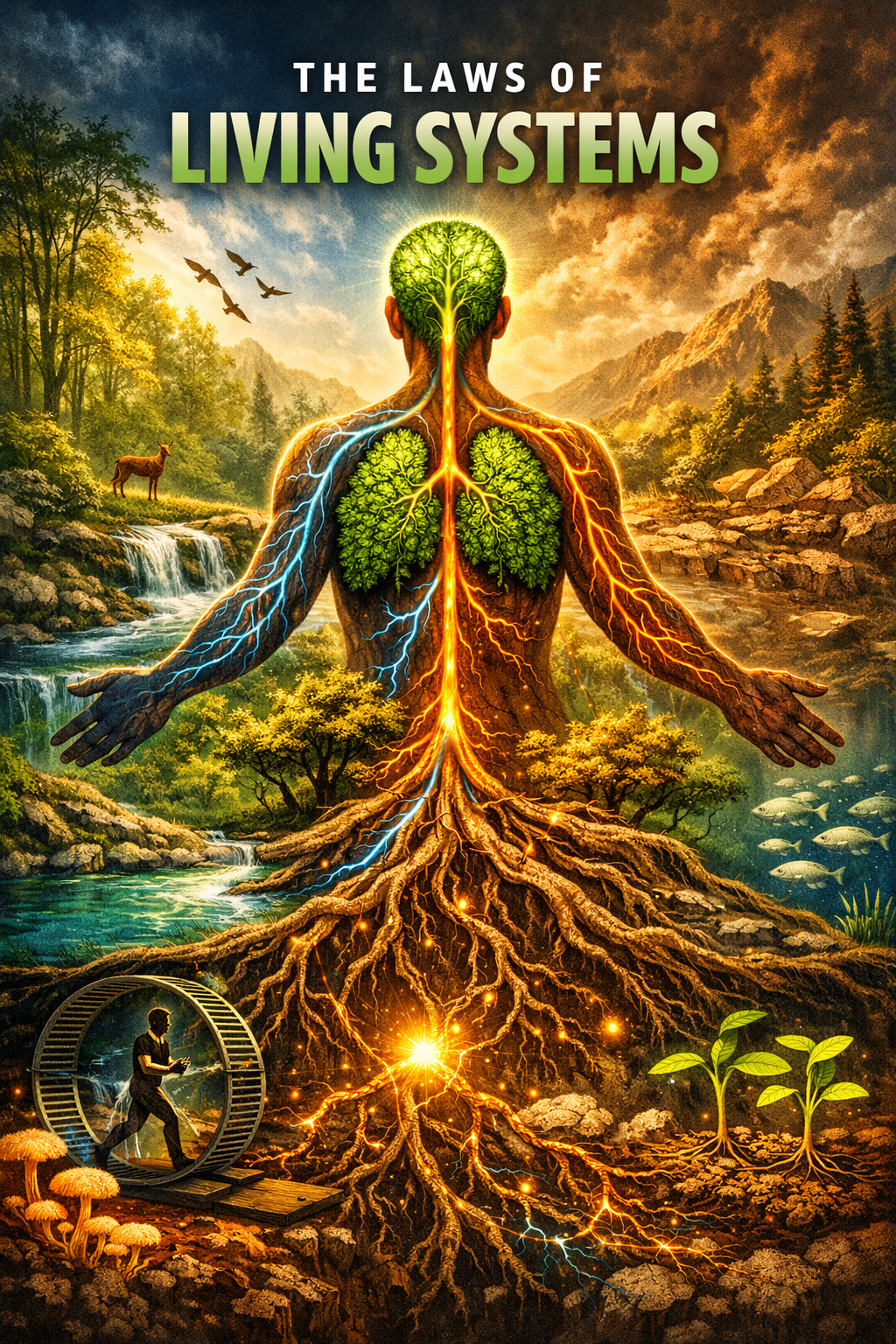
The Laws of Living Systems
Having traced the extraordinary success with which modern civilization learned to command external sources of energy, we arrive at a different question altogether. Before asking whether anything has gone wrong, we must first ask a simpler question: what does healthy life actually look like? Not morally, politically, or psychologically, but structurally. If we wish to claim that something has become distorted, we must first understand what an undistorted state might be.
This is a surprisingly difficult question because modern thought has become deeply accustomed to studying life by breaking it into disciplines. Biology studies organisms. Psychology studies minds. Economics studies markets. Sociology studies groups. Ecology studies environments. Each discipline has produced remarkable insights, yet the divisions themselves sometimes obscure a more fundamental observation. Whether we examine a forest, a coral reef, an immune system, a nervous system, a family, or even a thriving organization, certain patterns appear with remarkable consistency. The components differ enormously. The governing relationships often do not.
Physicists do not expect gravity to operate differently because an object changes shape. Likewise, it is worth asking whether there exist broad energetic tendencies that remain recognizable across the astonishing diversity of living systems.
One immediately encounters a curious fact. Healthy living systems rarely exist in static equilibrium. They move. They fluctuate. They oscillate. The human heart contracts and relaxes. Lungs alternate between inhalation and exhalation. Sleep and wakefulness form complementary halves of a single rhythm. Forests experience growth, decay, renewal, and succession. Populations rise and fall. Even emotional life unfolds through continual movement rather than permanent stability. Health is seldom the absence of change. More often it is the successful navigation of change.
This observation matters because modern language frequently equates health with constancy. We speak of maintaining performance, sustaining productivity, or remaining consistently efficient, as though the ideal state were one of uninterrupted output. Yet the biological world suggests something quite different. Living systems remain alive precisely because they are capable of alternating between expenditure and recovery. Rest is not an interruption of function. It is one phase of function itself. Growth is inseparable from repair. Activity is inseparable from restoration. Oscillation is not evidence of weakness but one of the defining characteristics of vitality.
Equally striking is the role of feedback. Living systems do not merely expend energy; they continually sense the consequences of their own activity and adjust accordingly. A healthy body regulates temperature, blood sugar, hydration, and countless other variables through feedback loops operating beneath conscious awareness. Ecosystems respond to changing conditions through innumerable interactions among species. Even healthy relationships depend upon continual communication, correction, and adaptation rather than rigid adherence to a predetermined plan. Stability, in living systems, is rarely imposed. It is continuously negotiated.
A similar pattern appears in the movement of tension itself. Energy that enters a living system does not simply accumulate indefinitely. It is transformed, discharged, redistributed, or integrated. Muscles contract and release. Tears often follow grief. Laughter follows relief. Sleep consolidates experience that waking consciousness cannot fully process. Rivers flow because water does not remain indefinitely where it first arrives. Healthy systems are characterised not by the absence of pressure but by their capacity to allow movement through pressure without becoming permanently trapped by it.
This principle extends beyond physiology. Trust within a community depends upon continual exchanges rather than indefinite accumulation. Knowledge advances through cycles of hypothesis, criticism, revision, and discovery. Economies circulate resources. Ecosystems circulate nutrients. Blood circulates oxygen. Wherever life persists, one repeatedly encounters movement rather than stagnation. What remains healthy is seldom what remains fixed.
None of these observations require belief in mystical forms of energy. They emerge from ordinary observation. They are visible in physiology, ecology, systems theory, and even the rhythms of ordinary human experience. The language of energy, as it is used throughout this essay, is therefore not intended as a metaphysical claim but as a way of describing the capacity of living systems to perform work, maintain organization, adapt to change, and sustain themselves over time. The question is not whether energy exists. Every living organism depends upon it. The more interesting question is whether energy appears to move according to recognizable patterns, and whether those patterns place constraints upon the ways in which healthy systems can be organized.
If that is true, then an important implication follows. Civilizations are not external to life. They are constructed by living organisms, inhabited by living organisms, and sustained by living organisms. However sophisticated our technologies become, they cannot exempt us from the conditions under which life itself functions. A society may possess extraordinary wealth, remarkable engineering, and unprecedented productive capacity, yet still organize itself in ways that systematically frustrate the very dynamics upon which living systems depend.
The question is no longer whether modern civilization has become more powerful. It undoubtedly has. The question is whether, in mastering the manipulation of external energy, it has gradually forgotten the principles governing the movement of living energy itself.