
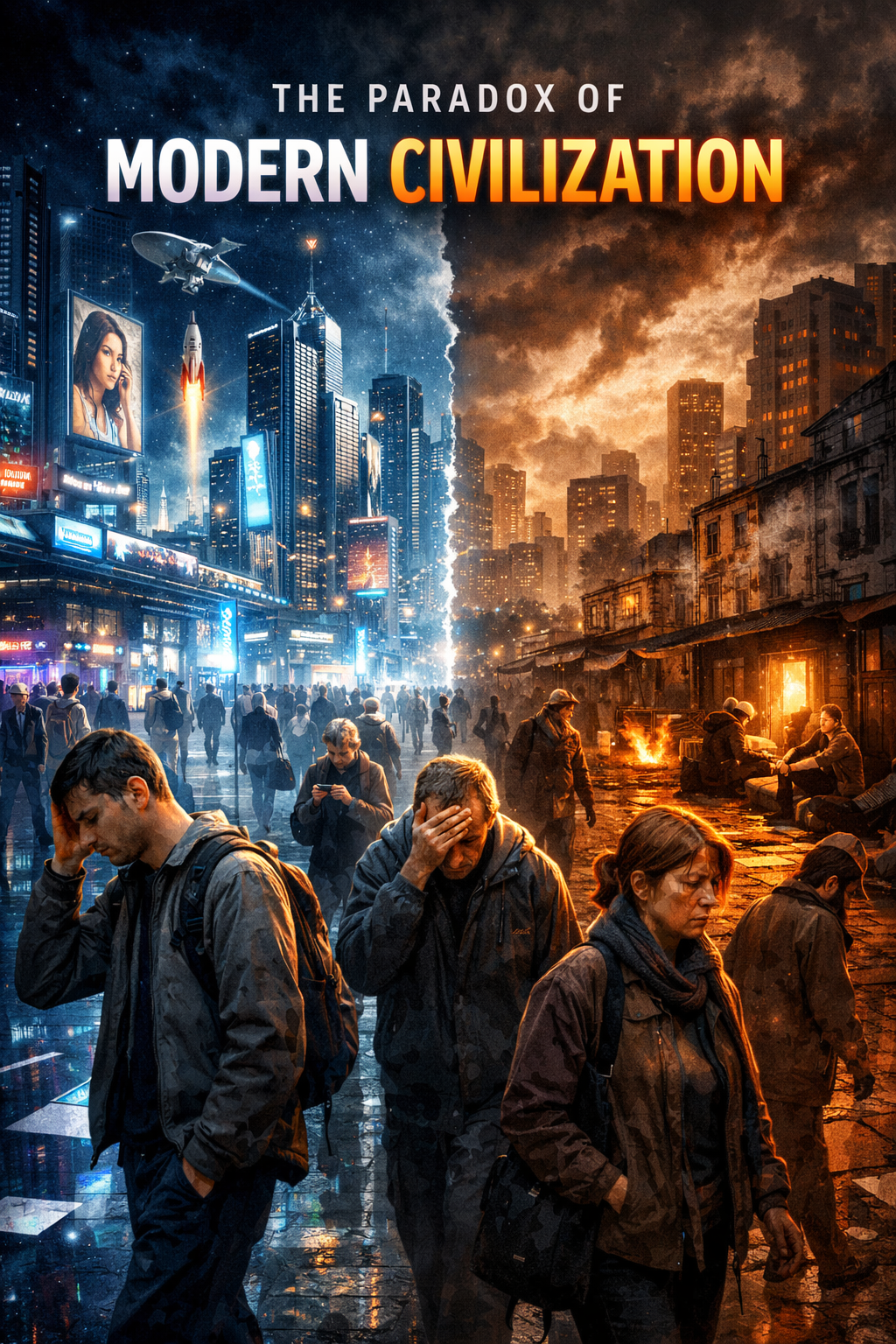
The Exhausted Civilization
Why Modern Life Has Forgotten How Living Systems Work
By Oluwakemi C. Amusan
Introduction
The Paradox
Every age inherits its own defining contradiction. Ours is not that we lack power. It is that we possess unprecedented power while feeling increasingly powerless. We have engineered machines that spare us physical labour, built technologies that collapse distance and time, and created systems capable of producing abundance on a scale unimaginable to previous civilizations. By almost every material measure, modern life has become more convenient.
Yet something refuses to add up. Over the past several decades, across some of the wealthiest and most technologically advanced societies on earth, rates of burnout, anxiety, chronic illness, loneliness, political polarization, and institutional distrust have moved in the same direction: up. We are surrounded by technologies designed to save effort, and exhaustion has become one of the defining experiences of modern life anyway. A civilization built on efficiency increasingly struggles to produce vitality.
The obvious explanation is that modern life has simply become more stressful. Another is that people have grown psychologically weaker. Others point to capitalism, technology, social media, or environmental decline. Each of these explanations captures something real. None is large enough to explain why crises emerging from such different domains keep moving together, as if they were coordinated.
This essay begins with a different question. Not why people are burning out. Not why society has polarized. But why so many of the defining problems of modern civilization appear to share the same underlying pattern, regardless of which discipline is called in to study them.
This is not an argument for returning to the past. The past was, in most ways, harsher than the present. People worked harder physically, died younger, and had far fewer comforts than we do now. Nostalgia is neither accurate nor useful here.
The puzzle is precisely that. If comfort has increased, why hasn’t vitality? Comfort was never the variable. We have mistaken convenience for health, and the principles that govern healthy living systems do not suspend themselves simply because our technologies grow more sophisticated.
That claim needs a definition before it can be trusted. When this essay refers to energy, it is not making a mystical claim. It means something ordinary: the capacity of a system, a body, a forest, an institution, to do work, adapt to change, and sustain itself over time. A river has energy in this sense. So does an immune system, a marriage, a national economy. The question this essay asks is whether that energy moves according to recognisable patterns, and whether those patterns place real constraints on how a healthy system can be organized, whether it is made of cells or of people.
The laws governing rivers, forests, ecosystems, immune systems, and nervous systems are not moral preferences. They are patterns through which living systems persist. Civilization has become extraordinarily skilled at manipulating energy outside itself: extracting it, storing it, accelerating it, directing it wherever it is needed. Whether civilization has become equally skilled at respecting the energetic principles operating within living systems, including the humans and institutions that compose it, is a separate question entirely.
That is the question this essay investigates. Not as a diagnosis to be treated symptom by symptom, but as a single pattern, hiding in plain sight across every domain we have trained ourselves to study separately.