
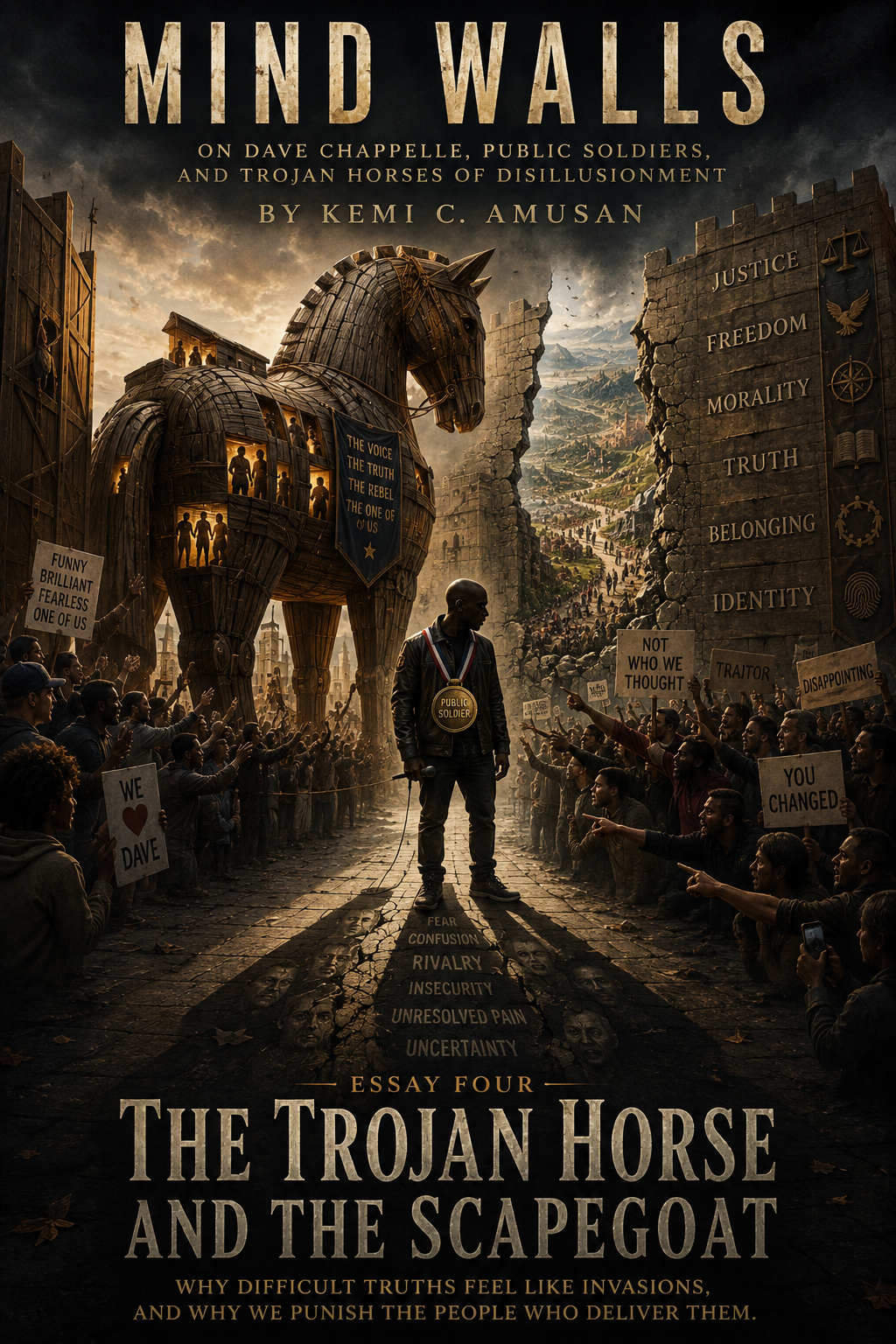
Mind Walls
On Dave Chappelle, Public Soldiers, and Trojan Horses of Disillusionment
By Kemi C. Amusan
Essay Four — The Trojan Horse and The Scapegoat
Why difficult truths feel like invasions, and why we punish the people who deliver them.
Reality rarely storms the walls we build around our understanding of the world. If it did, we would recognise it immediately and strengthen our defences. More often, it enters quietly, wearing the familiar shape of something we already trust.
History gave us the image through Troy.
The Greeks did not conquer Troy by breaking through its walls. The walls remained standing. The city’s defences performed exactly as they had been designed to perform.
The Trojan Horse arrived as a gift. Something beautiful, something desirable, something that seemed to confirm the story the city already wanted to believe. The siege was over. The threat had passed. The walls had held.
Troy’s security depended upon that assumption. After all, danger would announce itself as danger. And an enemy would carry the face of an enemy.
This large object outside their gate was different. It looked safe. It fit comfortably within the emotional landscape of victory. It did not look like something that needed to be defended against.
Only, it wasn’t safe at all.
That is what made the Trojan Horse such an effective instrument of destruction. It did not have to overcome Troy’s defences. It only had to be interpreted as something that did not require defence.
Our psychological lives are often organised in much the same way. The things most capable of unsettling our understanding are not always the things we recognise as threats. Sometimes they enter precisely because they arrive through a channel we already trust. They come disguised as entertainment, affection, admiration, familiarity, or even as something we have already accepted as part of our own world.
A comedian can become a symbolic landmark inside our internal country, a familiar figure we have already incorporated into the map by which we understand ourselves and the world around us. We may trust him, admire him, laugh with him, or even regard him as one of our own public soldiers. That familiarity lowers the psychological drawbridge.
And then he says something, does something, or refuses to say what we expected him to say, and suddenly the figure we had placed safely inside our world begins to expose the walls of that world. He reveals assumptions we had mistaken for unquestionable truths and makes visible borders we had stopped noticing because we had lived inside them for so long.
The unsettling part is not simply that he has changed.
It is that, through him, something we never expected to enter has found its way through the gates anyway.
We welcome people into our lives when they seem to confirm something our internal country already believes. The comedian validates our understanding of humour. The activist embodies our vision of justice. The politician reassures us that our tribe is on the right side of history. The celebrity gives a familiar face to values we already hold dear.
They become symbols in our inner country.
Landmarks that quietly help us orient ourselves within a complicated moral landscape. We use them to locate ourselves. They become reference points for what we believe is good, just, admirable, rebellious, moral or true.
But sometimes, like the Trojan Horse, the symbol we have constructed around them opens, and out steps a human being.
The humanity we overlooked has crossed the gates we unknowingly built for symbols alone.
A comedian who jokes one way about power may also choose to perform in a country we disapprove of. A politician who embodies dignity may also extend kindness to someone we have learned to regard as an enemy. An activist who has spent years championing one cause may remain silent about another. A celebrity who once seemed to represent our generation may make choices that no longer fit the story we first attached to them.
And now we have to carry the ambiguity that comes with that humanity: competing loyalties, private motivations, conflicting values and the untidy complexity that accompanies every ordinary life.
It is a lot to carry.
And according to the anthropologist René Girard, when we experience uncertainty, rivalry or the collapse of shared meaning, we rarely respond by carrying that complexity together. We look for someone who can carry it for us.
We gather our confusion and give it a face. A person becomes the explanation. The person becomes the container.
The individual may have made mistakes. They may deserve criticism for particular actions. But the intensity of the reaction can become disproportionate to the offence itself.
In doing so, we make the world feel coherent again, not because we have resolved its contradictions, but because we have found someone to blame for them.
We see this pattern everywhere. A family carrying generations of unresolved pain locates its dysfunction in one difficult child. A society undergoing rapid cultural change discovers a single public figure who somehow comes to represent everything that feels unfamiliar, unstable or frightening about the future.
Public figures become especially vulnerable because we first elevated them into symbolic offices. We asked them to represent justice, freedom, morality, rebellion, tradition or progress. Then they reminded us they were people.
And instead of asking what their humanity has revealed about the architecture of our own minds, we ask what is wrong with them. Instead of questioning the walls that have suddenly become visible, we defend those walls by attacking the person who exposed them. The discomfort of reconstruction is displaced onto an individual who can be criticised, condemned or cast out.
And just like that, the scapegoat is born.
Never mind that the scapegoat did not bring complexity into the world. Complexity was always there. The scapegoat simply carried complexity through the gates of a countries that loved affirming symbols.
And that is the deeper tragedy of the Trojan Horse.
We welcome symbols. We resist people.
And when the humanity we overlooked begins to rearrange our inner world, we pick the face that most clearly reveals that our walls were never the world.