
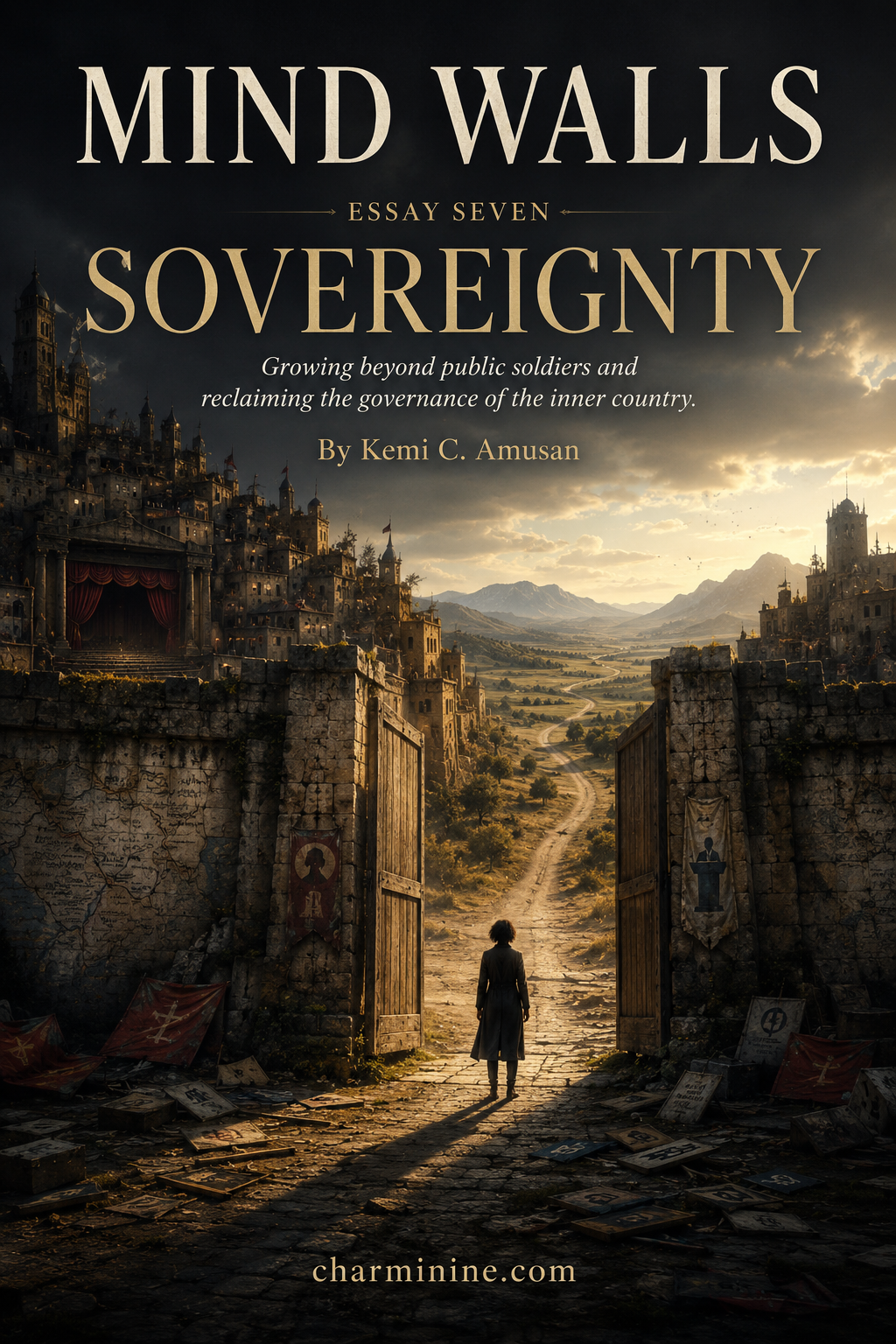
Mind Walls
On Dave Chappelle, Public Soldiers, and Trojan Horses of Disillusionment
By Kemi C. Amusan
Essay Seven –Sovereignty
Growing beyond public soldiers and reclaiming the governance of the inner country.
It is fashionably cynical to mistake demolition for wisdom, as though the person who believes in the fewest things must understand the world most deeply. That view is as immature as blind certainty. Human beings cannot live without meaning any more than we can live without shelter. The question was never whether we will build walls. We always will. The question is what kind of walls, how tightly we cling to them, and whether we remember that we built them.
Beyond the simple accumulation that comes with reading another book or learning another theory, real growth requires transformation. Otherwise, we are only collecting facts that leave us unchanged. For growth to occur, new understanding has to reorganise the frame through which we interpret everything else. The floor plan, not the furniture, is what changes the space.
Yet like every significant renovation, this type of growth asks that we become temporarily homeless; walls down, dust everywhere, nothing quite functional. The old explanations no longer satisfy and the new ones have not yet solidified. We stand, psychologically, among the rubble of our previous civilisation. The certainty we crave is exactly what we have to lose.
Outrage offers us shelter from that discomfort. It lets us rebuild the old walls before we have asked whether they deserved rebuilding at all. Instead of asking, what does this contradiction reveal about my understanding of reality? we ask, who is responsible for making me feel this way? One question leads to growth. The other leads to scapegoats.
It is possible the discomfort itself is the invitation. Every difficult conversation, every disappointing public figure, every book that refuses to confirm what we already believe, is an opportunity for expansion disguised as inconvenience. They feel like invasions because they arrive uninvited. And this is the real gift hidden inside the Trojan Horse – the seeds of renovation.
And the real service our public soldiers could offer us might be exposing that our walls had become too small for the life we are trying to live, rather than merely protecting our walls.
This does not mean every controversial idea deserves acceptance, or that every act of transgression is secretly profound. Complexity is not a licence to abandon judgment. It demands better judgment, because it removes the easy answers. The task is to distinguish a genuine threat to our principles from a threat merely to our comfort. Those are not the same thing, though outrage habitually confuses them.
Seen this way, adulthood becomes a movement away from dependency: away from relying on someone else to maintain our understanding of reality, the way a child inherits a map before they have the experience to draw one. It means becoming cartographers of our own minds, expanding our capacity to hold larger question.
It means recognising that our public soldiers were always temporary visitors, never permanent guardians. Refusing to hand comedians the keys to our conscience, or politicians the authority to organise our emotional life. They may inspire us. They may disappoint us. They may transform our understanding forever. But they were never appointed custodians of territory only we are responsible for.
This does not mean becoming cynical or detached from the world’s suffering. Quite the opposite.
It is sovereignty. Not independence from other people, not stubborn self-reliance, but the refusal to outsource the governance of our inner country.
The sovereign person often cares more, because they have stopped spending their energy defending symbolic wars. They become free to care about actual people instead of imaginary tribes. They stop asking whether someone belongs to the right camp before extending compassion.
In a society of people who no longer needed public soldiers to defend their inner worlds, public discourse would spend less time asking people to choose sides, and more time asking better questions. Less time defending tribes, more time defending principles. They become capable of disagreeing without requiring enemies, of changing their minds without psychological collapse. Their world would dignify disagreement rather than eliminate it.
There is another freedom rarely spoken about: the freedom to disappoint strangers. Every meaningful transformation eventually disappoints someone who preferred the earlier version of you. If you become more nuanced, someone will call you unreliable. If you become more compassionate, someone will mistake it for weakness. If you refuse to perform certainty where none exists, someone will accuse you of fence-sitting. That is often the price of intellectual honesty, which is why sovereignty tends to feel lonely before it feels like freedom. You can no longer treat applause as evidence you are thinking well.
The clearest expression of sovereignty is trading certainty for curiosity. Instead of whose side are they on, ask what might they be seeing that I can’t. Instead of how could they betray us, ask what assumptions did I make about them that they never made about themselves. Curiosity doesn’t require agreement. It requires courage, because a genuinely curious question risks changing the person who asks it. That is why it feels more dangerous than outrage. Outrage protects identity. Curiosity transforms it.
There is, after all, a difference between defending a civilisation and defending every wall inside it. Walls are a means. Civilisation is the end. When a wall no longer serves the life it was built to protect, wisdom lies in redesigning it: sometimes strengthening a boundary, sometimes opening a gate, sometimes admitting that an entire district was built on assumptions that can no longer bear the weight we’ve asked of them
Reality has a habit of arriving disguised as betrayal – in the friend who won’t hate who we hate, the joke about something we consider sacred, the politician who treats an opponent with unexpected dignity, the stranger whose life won’t fit our categories. Again and again the gates open on something that was not supposed to enter. Panic follows. And years later, we discover that the very idea we resisted most fiercely has quietly become part of the architecture of the wiser person we became.