
The Exhausted Civilization
Why Modern Life Has Forgotten How Living Systems Work
By Oluwakemi C. Amusan
Chapter One
The Industrial Energy Economy
Every civilization can, in some sense, be understood by the forms of energy it learns to command. The story of human progress is not merely the story of ideas, inventions, or political institutions. It is also the story of humanity’s growing ability to capture, store, transport, and direct energy. Fire allowed us to unlock nourishment that had previously been inaccessible. Agriculture transformed sunlight into reliable stores of food. Rivers were harnessed to power mills, wind filled the sails that connected continents, and eventually coal, oil, and electricity gave humanity access to forms of power so immense that previous generations could scarcely have imagined them. What distinguishes modern civilization is not simply that it became technologically advanced, but that it became extraordinarily adept at mastering external sources of energy.
This achievement should not be understated. It lengthened life expectancy, reduced famine, transformed medicine, accelerated scientific discovery, and liberated millions from forms of physical labour that had defined human existence for centuries. The conveniences of modern life are real, and so are the benefits they have brought. It would be intellectually dishonest to dismiss industrialization as though it were simply a mistake. It solved genuine problems, relieved genuine suffering, and expanded human possibility in ways that deserve admiration. Any serious examination of the modern world must begin by acknowledging that reality rather than romanticizing the past.
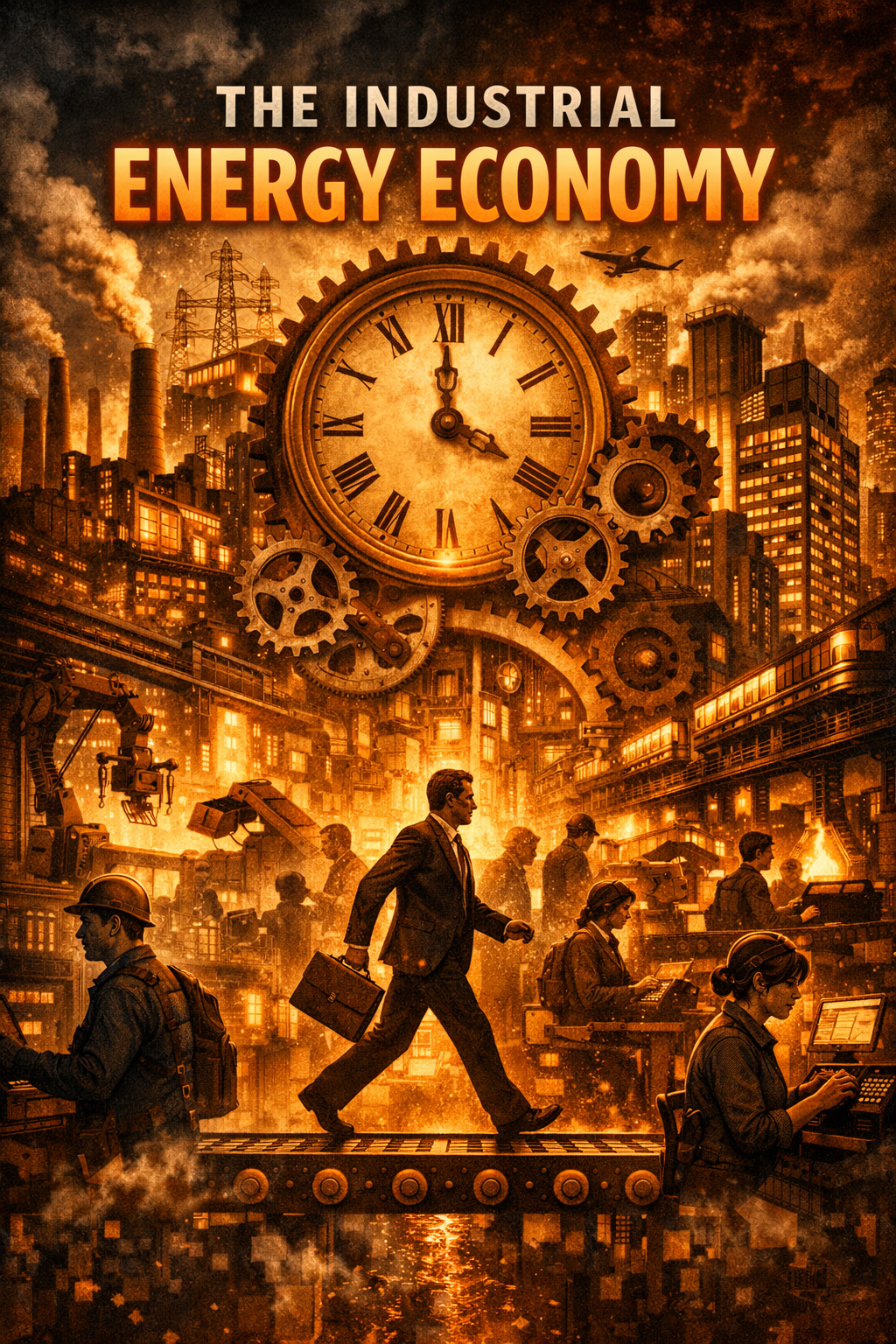
Yet every technological revolution does more than provide new tools; it quietly reshapes the assumptions through which a civilization organizes itself. The Industrial Revolution did not merely introduce machines into factories. It introduced an entirely different relationship with time, work, productivity, and ultimately with energy itself. Activities that had once been governed largely by natural rhythms became synchronized to clocks. Seasonal variation gave way to standardized schedules. Productivity became measurable, efficiency became quantifiable, and continuous output increasingly became the ideal toward which institutions aspired. The factory was never merely a place where goods were manufactured. It became a model for organizing society.
This shift represented one of the greatest triumphs of human ingenuity. For the first time in history, energy could be extracted, stored, and deployed on a scale that seemed almost limitless. Coal did not tire. Steam engines required no sleep. Electric light dissolved the practical significance of sunset. As industrial civilization matured, the ambition to overcome natural limitations gradually extended beyond machines themselves. Artificial light lengthened the productive day, clocks disciplined human behaviour with unprecedented precision, transportation collapsed geographical distance, and communication eventually collapsed temporal distance as well. Each innovation solved a legitimate problem. Each expanded what human beings were capable of accomplishing. Yet together they also began to normalize a new expectation: that the limits previously imposed by nature were obstacles to be overcome rather than rhythms to be understood.
Yet, while Modern civilization became remarkably sophisticated at manipulating energy outside the human body, yet comparatively little attention was given to the possibility that living systems might obey principles fundamentally different from those governing machines. An engine can often be made more productive by increasing its fuel supply or extending its hours of operation. Living organisms do not function so simply. They fluctuate. They recover. They adapt. They require periods of restoration no less than periods of expenditure. Their vitality depends not merely upon the quantity of energy available, but upon the patterns through which that energy moves.
This distinction is easy to overlook because the successes of industrial civilization have been so extraordinary. When a particular way of organizing society generates unprecedented prosperity, it is tempting to assume that its underlying logic is universally applicable. If factories become more efficient through standardization, perhaps schools should operate similarly. If businesses maximize output through continuous optimization, perhaps human beings should as well. If technology enables uninterrupted productivity, perhaps uninterrupted productivity itself becomes the measure of progress. Gradually, almost imperceptibly, the organizing principles developed to optimize machines begin to migrate into institutions built for living organisms.
None of this requires conspiracy or malice. No single individual decided that human beings should increasingly adapt themselves to industrial rhythms. Rather, it emerged as the cumulative consequence of countless rational decisions, each solving an immediate problem, each increasing efficiency, each appearing beneficial in isolation. Yet systems often produce outcomes that none of their participants consciously intended. A civilization may become extraordinarily effective at manipulating external energy while simultaneously becoming increasingly disconnected from the principles through which living energy sustains itself.
Mastering the mechanics of energy is not the same as understanding the dynamics of life. The two overlap, but they are not identical. If the forms of organization that have made our civilization so materially successful are also subtly incompatible with the energetic behaviour of living systems, then the epidemics of burnout, anxiety, loneliness, polarization, and ecological degradation may not be isolated crises after all. They may instead be different expressions of a deeper misalignment, one that can only be understood by first asking how life itself appears to move.