
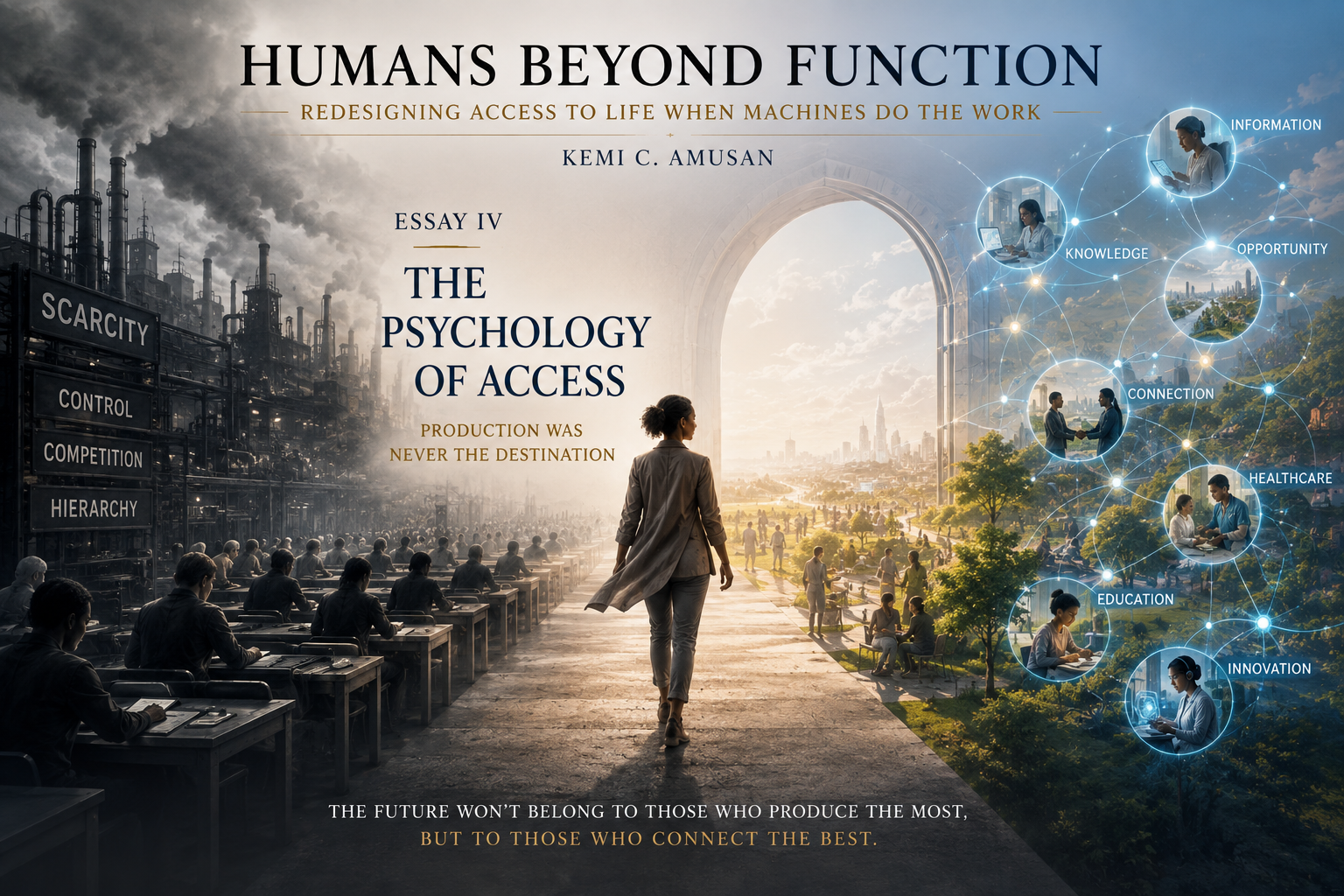
Humans Beyond Function
Redesigning Access to Life When Machines Do the Work
Kemi C. Amusan
ESSAY IV
The Psychology of Access
Production Was Never the Destination
Throughout the previous essays, we have argued that artificial intelligence does not simply disrupt labour markets. It exposes assumptions that industrial civilization quietly absorbed over generations. We organized education around employability because production required skilled workers. We organized adulthood around careers because economic participation depended upon sustained labour. We gradually came to locate identity, dignity, belonging, and security within employment because employment became the principal gateway through which people entered society. None of this emerged from malice. It emerged because, for a remarkably long period of history, production and human labour remained inseparable.
Artificial intelligence reveals that this historical relationship is beginning to loosen.
The significance of that shift compels civilization to ask whether the question that has dominated the last two centuries is still the question that should dominate the next. Industrial civilization largely asked how humanity could produce more efficiently, distribute resources more effectively, and organize labour more productively. Those were the right questions for an age in which scarcity remained the defining constraint upon collective life. They produced extraordinary achievements because they addressed genuine problems.
But every question belongs to a particular historical moment. A civilization that continues asking yesterday’s questions after the conditions that gave rise to them have changed risks becoming trapped by its own success. Progress sometimes requires discovering that a different question has become more important.
The extraordinary expansion of productive capacity now forces humanity toward precisely such a moment. Machines continue becoming more capable. Scientific knowledge continues expanding. Entire industries now produce abundance with remarkably small amounts of human labour compared to previous generations. None of this eliminates scarcity altogether, nor does it remove the need for work. There remain billions of people who lack adequate food, healthcare, housing, education, or economic opportunity. Production therefore remains indispensable. Yet indispensability is not the same as purpose. A civilization may need to produce in order to survive without needing production to remain the organizing principle of human life.
Seen from this perspective, the question is no longer simply how civilization creates value, but how civilization enables people to participate in it.
The Psychology of Access
If production is a technical challenge, access is first a psychological one. Civilizations produce assumptions that become so deeply embedded within ordinary life that they eventually appear to be common sense. They shape what societies perceive as possible, what they regard as fair, and even what they consider inevitable. The institutions that govern economic life therefore reveal the psychology through which a civilization understands itself.
Industrial civilization emerged under conditions in which scarcity was a defining feature of human existence. When resources appear limited, fear becomes rational. It encourages accumulation because tomorrow cannot be guaranteed. It encourages competition because another person’s gain appears inseparable from one’s own loss. It encourages hierarchy because scarce resources require mechanisms for deciding who receives them first. It encourages control because uncertainty feels dangerous. These psychological responses were understandable adaptations to environments in which survival remained uncertain.
The remarkable achievement of industrial civilization was that it gradually reduced many of the material conditions that produced those fears. Agriculture became more productive. Manufacturing became more efficient. Transportation became faster. Medicine extended life expectancy. Computing expanded access to information. Yet while productive capacity transformed dramatically, the psychology built under scarcity often remained remarkably intact.
This should not surprise us. Human psychology evolves far more slowly than technology. Institutions therefore often continue operating according to historical realities that have already begun changing. Habits that once protected society from genuine scarcity can become embedded within structures long after the conditions that originally justified them have weakened. What once represented wisdom can slowly become inertia. Nowhere is this more visible than in the relationship between control and access.
Throughout history, control frequently appeared synonymous with security. Kings controlled land. Governments controlled borders. Guilds controlled professions. Universities controlled credentials. Corporations controlled production. Information itself was often valuable precisely because access to it remained limited. To possess something others could not easily obtain was to possess power. The digital age quietly disrupted that assumption.
Like some of the most transformative innovations of the last three decades, digitization became valuable because it radically expanded access to information beyond the limits imposed by previous institutions. Search engines made the world’s knowledge more discoverable. Digital maps reduced the friction involved in navigating geography. Streaming platforms reorganized access to music and culture. Artificial intelligence may follow a similar pattern because it dramatically expands access to forms of knowledge and expertise that were once available only to relatively small groups of specialists.
This distinction matters because it reveals value increasingly emerges not only from ownership, but from connection. The ability to organize, integrate, discover, and circulate resources becomes as important as producing those resources in the first place.
That observation extends well beyond technology.
For instance, a public library does not increase the number of books that exist in the world. Its achievement lies in lowering the barriers separating people from knowledge. It transforms books from private possessions into shared resources. The institution creates extraordinary value by redesigning access.
The same pattern appears repeatedly across civilization. Many of the most successful innovations reveal possibilities that were already present but previously inaccessible. They connect people to information, buyers to sellers, communities to capital, patients to healthcare, students to education, and ideas to the people capable of developing them further. Their achievement lies not simply in creating new resources, but in reducing the distance between existing value and the people who can benefit from it.
This suggests that access possesses a psychology quite different from production.
Where production asks, “How do we create more?”, access increasingly asks, “What prevents people from reaching what already exists?”
Where production emphasizes accumulation, access emphasizes connection.
Where production often rewards control, access frequently rewards discoverability.
Where production seeks greater output, access seeks lower friction.
These are complementary philosophies. Production remains indispensable because there must be something to which access can be provided. Yet a civilization that becomes extraordinarily skilled at production without becoming equally skilled at access risks generating abundance while leaving unnecessary barriers standing between people and that abundance.
This distinction helps explain why so many contemporary frustrations resist purely economic solutions. In many parts of the world, exclusion occurs not simply because nothing exists, but because existing opportunities remain difficult to reach. Education may exist but remain financially inaccessible. Healthcare may exist but remain geographically distant. Employment opportunities may exist but remain hidden behind networks unavailable to many applicants. Information may exist but remain fragmented across countless platforms. Innovation itself often depends less upon creating entirely new resources than upon connecting resources that previously remained isolated from one another. The problem, increasingly, is not always the absence of value but the friction between existing value and the people capable of benefiting from it.
In this sense, access is fundamentally concerned with relationships.
It asks how people relate to knowledge, institutions, opportunities, technologies, communities, and one another. It asks why value frequently remains trapped inside systems that fail to connect with those who need it most. It asks why unnecessary friction persists long after the technologies capable of reducing it have emerged.
These are psychological questions before they become institutional ones.
A society that instinctively sees every interaction through the lens of competition will design different institutions from one that increasingly recognizes the value of participation. A society governed primarily by fear will organize access differently from one grounded in trust. A civilization convinced that control is the only reliable path to security will inevitably produce institutions different from one that understands connection itself as a source of resilience.
This does not imply that trust should replace prudence or that openness should eliminate every form of boundary. Every civilization requires rules, incentives, responsibilities, and institutions capable of maintaining order. The challenge is not abandoning these realities. It is recognizing when assumptions inherited from an age dominated by scarcity continue limiting possibilities in an age whose defining challenge may increasingly lie elsewhere.
This might be the deepest psychological transition now beginning to emerge. The civilization now taking shape may increasingly require humanity to become extraordinary connectors. It may reward those capable of integrating fragmented systems, revealing hidden value, reducing unnecessary barriers, and designing institutions through which more people can participate in the opportunities civilization has already created.